Reuse of technical equipment – a logistical and organisational challenge
Reading time: 4 min
Stop calling it waste! Items obtained from deconstruction projects can now be reused and enjoy a second life. RESO Services is part of this virtuous circular economy sector, in which a disciplined approach to logistics is key.
©Raphaël Soret
Based in Blanc‑Mesnil, near Le Bourget Airport, just 8 km north of Paris, the VINCI Energies subsidiary RESO Services was formed in 2020 to facilitate construction site logistics for Group business units. The firm specialises in the reuse of technical equipment including ventilation ducts, cable trays and sanitary ware. These three equipment streams were chosen for their strong market demand and potential for reuse, and are now fully operational thanks to the business unit’s logistics expertise.
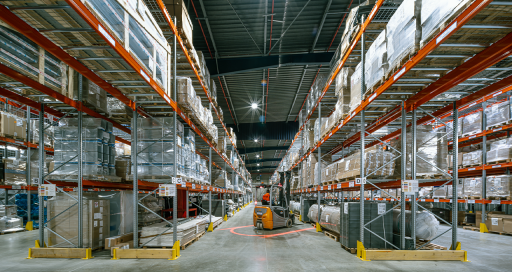
“Logistics is a fundamental element of reuse,” explains Manuel Da Silva, Business Unit Manager at RESO Services. “Having the means to transport, store and recondition items is essential. Too many initiatives fail because they underestimate this factor.” Here, a 7,000 sq. metre depot performs all these functions and enables the business unit to operate across the entire value chain: from the recovery and reconditioning of equipment from gutted buildings to storage, traceability and delivery to a new location.
A well-oiled machine
In the building sector, rigorous processes are the key to implementing reuse. It all begins with collecting the items. “Sourcing is crucial. Nothing can happen without resources to reuse,” says Juliana Ton That, Reuse Project Manager. RESO Services works on deconstruction operations across Ile‑de‑France and occasionally other regions, alongside various operators in the sector: demolition firms, builders, project management providers, environmental specialists, etc.
“Obligations relating to the circular economy are beginning to transform the sector, but we need to go further.”
They buy back equipment rather than simply reclaiming it: “These parts will have a new life and must not be damaged,” explains Julian Ton That. “Careful removal takes longer than straightforward demolition, so we pay for that.” The parts are then reconditioned, either internally or by partner organisations. Most of these operations are performed by workers in employability support schemes. RESO Services has also developed specific reconditioning processes for each stream, which ensure the equipment’s quality and traceability.
Facilitating reuse
The business unit has the logistical means to encourage reuse backed by an extremely fluid supply chain. This includes the development of new quality standards similar to those covering new equipment in terms of technical specifications, identification and packaging. The goal is to make the installation of reconditioned equipment as easy as using new, standardised equipment from the factory.
RESO Services is positioned as a reuse facilitator, offering the construction sector custom solutions on a case-by-case basis. For example, on a recent project where the customer was unable to independently manage transportation of the equipment, RESO Services sent a truck-mounted crane to collect the materials from where the workers had left them by prior arrangement. This initiative was greatly appreciated by the time-poor project teams.
RESO Services offers its customers a wide range of bespoke services to meet their specific needs, from logistics, transportation, storage and palletisation to dedicated work spaces. It is proving that with meticulous organisation and control of the entire supply chain, it is possible to simplify reuse and make it available to all.
Short and long-term benefits
The next stage is to make reuse the default. “Obligations relating to the circular economy are beginning to transform the sector, but we need to go further to systematically incorporate reuse into calls for tender and project specifications,” says Manuel Da Silva.
Will reuse be the standard for future construction projects? Its short and long-term benefits are undeniable: savings on equipment purchases, reduced waste management costs, and a boost to CSR initiatives in the companies involved. It has contributed to a considerable reduction in the construction sector’s environmental impact: in four years, the reuse stream built by RESO Services has eliminated 65 tonnes CO2 equivalent of emissions.
12/15/2025