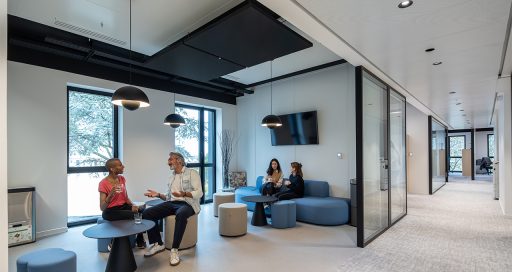
HKR Citycampus: a second life for this former shopping centre as a future-oriented campus
Reading time: 4 min
In Kristianstad, Sweden, the former Galleria Boulevard shopping centre is to be transformed into a sustainable university campus. HKR Citycampus combines education, innovation and ecology in the city centre.

In Kristianstad in southern Sweden, the Galleria Boulevard shopping centre is poised to take on a radical new form. One-third of the retail space has remained vacant since its construction in 2015. That part is currently being dismantled, with 10,000 sq. metres of concrete slabs to be repurposed in the largest concrete reuse project in Swedish history – a joint enterprise between the construction firm Skanska and property developer Boulevardfastigheter.
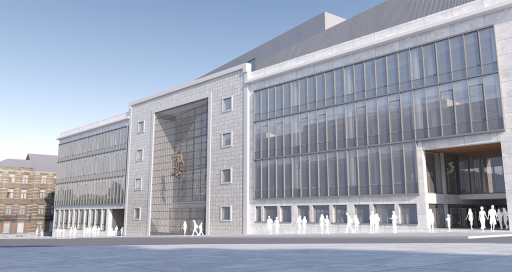
A few years from now, this will become the site of the new Kristianstad University (HKR) campus in a landmark sustainable urban renovation project. The future HKR Citycampus, developed by Boulevardfastigheter AB, a subsidiary of the municipal company AB Kristianstadsbyggen, aims to bring university life closer to the city centre and meet the university’s needs in terms of infrastructure better suited to its operations.
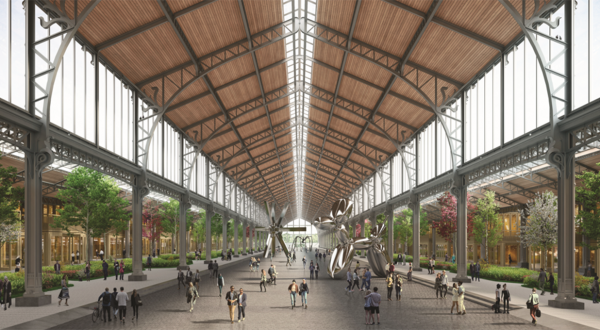
On the new campus, the university, currently located five kilometres away in Näsby, will find spaces dedicated to teaching, research and student living, along with cafes, green spaces, and a library open to the public.
Sustainable city-centre development
“Part of the shopping centre will be demolished, and it will also be necessary to acquire adjoining land,” explains Björn Dahlström, Design Manager at Eitech, the VINCI Energies subsidiary responsible for the design and installation of electrical, lighting, telecommunications and security systems on the future site. The project is currently in the study and design phase and will run until 2029. “We have been working on the design and the first-phase cost estimates since last spring. If everything is approved, the detailed design phase will start in early 2026, with earthworks to follow in the second quarter. Delivery is expected in the third quarter of 2029.”
Reusing, optimising and pooling resources
The two objectives of the project are to create a modern, eco-responsible campus and to revitalise the city centre. Its distinguishing features include a circular approach and the constant pursuit of technical efficiency. “We will be reusing existing mains-voltage electrical equipment,” says Björn Dahlström. “We also hope to reuse and adapt the bus bars* that are already there.” This reuse strategy is part of an environmental approach designed to minimise construction waste and the project’s carbon footprint.
“A flagship project for intelligent restructuring, combining education, technology and sustainability in the heart of the city”
The pooling of technical resources is another key element of the project. “Rather than installing one sensor for the lighting and another for the ventilation, we are using a single integrated system,” the project manager explains. “This does reduce energy consumption slightly, but it’s really an ecological move, more about reducing the number of products.”
Eitech is also collaborating on the implementation of a shared energy network, exploring the possibility of exchanging solar electricity between a campus building and those around it. “The project is studying solutions for sharing the solar energy produced, which is an innovative approach for a city-centre installation.”
A demanding operation in an urban environment
The campus location in the centre of Kristianstad means that meticulous planning is required. “As the project is right in the city centre, traffic flows to and from the site have to be maintained,” explains Björn Dahlström. Coordination between the different contractors, the circulation of materials, and the continuity of urban networks requires detailed organisation.
In 2029, when HKR Citycampus opens its doors to students, the entire city will benefit. The university will gain direct proximity to the city’s residents, shops and cultural life. With the reuse of existing infrastructure, technical innovations, and ambitious ecological goals, the aim of this project is to demonstrate a new way of thinking about university cities.
“HKR Citycampus is a flagship project for intelligent restructuring, combining as it does education, technology and sustainability right in the heart of the city,” concludes Björn Dahlström.
*Bus bars are conductive strips used to effectively and efficiently distribute electrical power.
02/16/2026