A railway station in Brussels transformed into a sustainable mini-city
Reading time: 3 min
A former rail freight station in Brussels, the Gare Maritime has been reborn as a sustainable mini-city offering workplaces, shops and events. This huge wood-built energy-positive building is one of the most ambitious renovation projects in Europe.
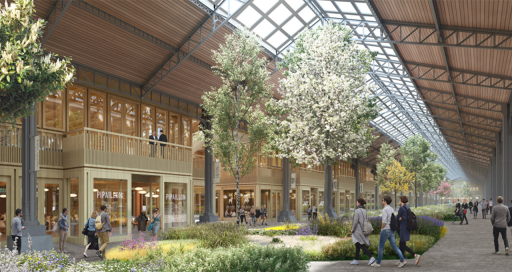
© Nextensa
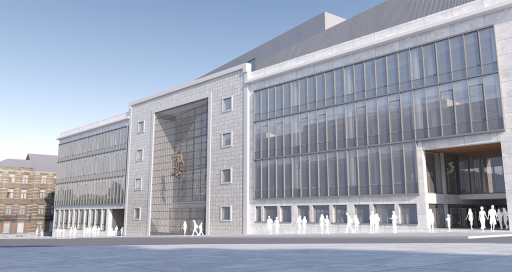
At the heart of the Tour & Taxis site, the former Brussels freight station has been reborn as a veritable covered mini-city, energy-neutral and open to the public. 280 meters long, 140 meters wide, and 24 meters high, this iconic railway building, in operation until the 1980s, now houses twelve wooden pavilions dedicated to work, commerce, and events. With their 10,000 m³ of timber, the pavilions and staircases represent the largest timber construction project in Europe.
An exemplary approach to sustainability
The complex is organized around a spectacular, light-filled nave punctuated by ten themed gardens. This space hosts cultural events, markets, festivals, and the popular Food Market. Located near the Gare du Nord (North Station), the KANAL Centre Pompidou museum, and the Tour & Taxis park, the Gare Maritime is part of a rapidly transforming neighborhood.
The renovation, led by property developer Nextensa, is distinguished by its exemplary approach to sustainability: BREEAM Outstanding certification, solar facades, 9,750 photovoltaic panels producing 3 million kWh/year, natural ventilation, rainwater harvesting, and geothermal heating/cooling.
Deep geothermal energy storage
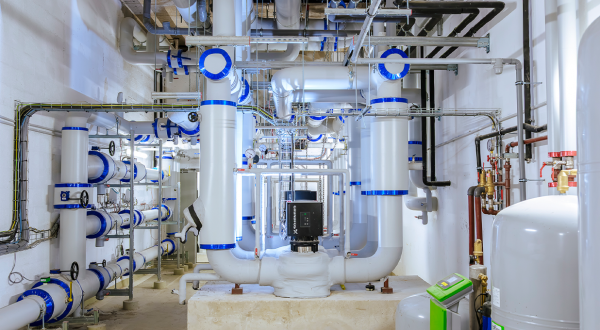
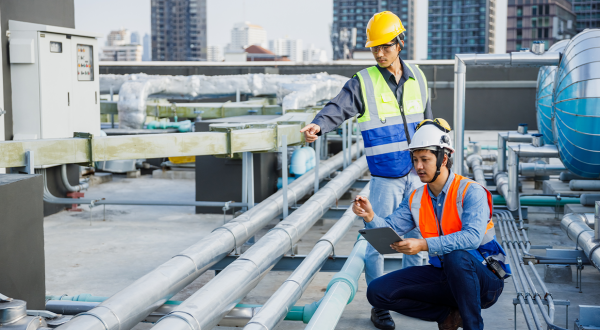
Cegelec HVAC Commercial North (VINCI Energies Building Solutions) played a key role in this transformation. “We started work in December 2018, and provisional acceptance took place in June 2020. We are currently continuing the fit-out work,” explains Sebastiaan Smits, Project Manager. The company installed all the HVAC systems for the twelve pavilions, as well as the underfloor heating in the Food Market. Integrating a geothermal system, based on deep geothermal energy storage, represented a major challenge. “All the blocks are connected to a closed-loop system, which required very precise programming,” emphasizes Sebastiaan Smits.
“The goal was to create a net-positive energy site, with the geothermal energy storage system playing a key role in heating and cooling.”
The goal was to create a net-positive energy site, with the geothermal energy storage system (BTES) playing a key role in heating and cooling. “Heating is provided by a water-to-water heat pump for each building,” explains the Project Manager, “and cooling is entirely passive, via a heat exchanger connected to the BTES system. Heat and cold are distributed through radiant ceilings and floors (low-temperature heating and high-temperature cooling). In addition, the air handling units are equipped with integrated heat pumps, a humidification system, and an adiabatic cooling system using rainwater harvesting.” The 100% CLT* construction also required meticulous preparation, particularly regarding fire safety. The Gare Maritime thus illustrates the convergence of heritage, technical innovation, and climate transition—a demonstration of sustainable architecture in the heart of Brussels.
*CLT (Cross Laminated Timber) is a solid, cross-laminated structural panel made up of several layers of softwood.
02/16/2026