Formula Student: a formative partnership for the engineers of tomorrow
Reading time: 11 min
As its third year sponsoring the FST Lisboa team from the Instituto Superior Técnico begins, VINCI Energies Portugal reports extremely positive initial results from this partnership in Formula Student, one of the biggest international student automotive engineering competitions.
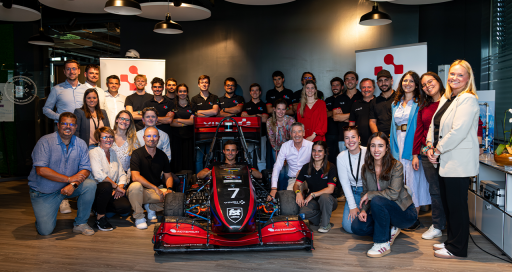
As it begins a third year sponsoring the FST Lisboa team from the Instituto Superior Técnico (IST), VINCI Energies Portugal reports extremely positive initial results from this sponsorship in Formula Student, one of the biggest international student automotive engineering competitions.
Beyond the technological and sports performance aspects, this collaboration illustrates VINCI Energies’ long-term commitment to training engineers and strengthening links between industry and academia.
Founded more than 40 years ago, Formula Student is far more than a motor racing competition. It is an educational platform where teams of students design, develop and race single-seater cars, combining technological innovation, performance, design and economic viability.
The FST Lisboa team from the Instituto Superior Técnico, Portugal’s largest engineering school, competes in the electric (EV) and driverless (DV) categories, both of which are closely aligned with the strategic priorities of VINCI Energies.
“These categories are directly linked to our activities and our ambition to accelerate the digital transformation and the energy transition,” observes Nuno Caldeirinha, Chief Financial Officer at VINCI Energies Portugal.
A constantly evolving experience
Season by season, FST Lisboa has shown consistent progress, both technologically and organisationally. Progress that the VINCI Energies Portugal CFO has been following closely: “FST Lisboa has shown constant and solid evolution year on year. The team analyses the lessons learned, identifies areas for improvement and is constantly pushing the limits. This mindset is what really drives the project, on both the technical and the organisational level.”
A laboratory for project management, leadership and interdisciplinary working
The close relationship established between the team and VINCI Energies Portugal plays a key role. Nuno Caldeirinha adds that “Thanks to our close relationship with the team – an approach we encourage in all our partnerships – I’ve been able to watch their processes mature: they more quickly find solutions and learn from their past mistakes, with greater agility and an ever-clearer vision.”
A integrated approach to performance
To design a Formula Student racing car, teams must be able to master and articulate multiple disciplines: mechanical engineering, onboard electronics, software, and racing strategy. For VINCI Energies, FST Lisboa’s strength lies precisely in its ability to take an overarching view of the project.
“The team doesn’t consider the design, electronics or mechanical engineering in isolation,” explains Nuno Caldeirinha, “but as interdependent elements that have to work together for optimal performance.” In practical terms, this integrated approach is evident in the quality of the prototype and the results achieved on Europe’s racing circuits.
Beyond the technical aspects, Formula Student is effectively a laboratory for project management, leadership and interdisciplinary working. All of which are essential skills for the engineers of tomorrow.
“Building a prototype forces the students to address complex problems, make decisions and coordinate their efforts in different fields,” says Nuno Caldeirinha. “They are developing their leadership skills and gaining practical experience of managing deadlines, uncertainty and stakeholder expectations.”
Going beyond financial support
The collaboration with VINCI Energies also helps to make the various interactions more professional. “The students get used to professional communication practices and organisational dynamics, which helps them to express their technical ideas clearly and effectively.”
Under the competition rules, sponsors are not allowed to directly influence the vehicle’s design, but VINCI Energies fully embraces the role of committed partner. From financial support to help with communications and immersion in the corporate environment, the partnership is designed to be comprehensive.
“I see our role as that of a catalyst,” says Nuno Caldeirinha. “Our responsibility is to give the team the means to go further than it would working alone. A sponsor shouldn’t be content with bankrolling the project; it should be present and fully committed to the students’ development.”
This commitment was perfectly illustrated by the welcome extended to students at the VINCI Energies Digitalschmiede in Frankfurt, the Group’s flagship demonstration hub, from VINCI Energies Germany. Or even the valuable support of VINCI Energies Spain. This partnership, based on VINCI Energies model and culture, strengthens links between the students and the Group’s international teams.
Multiple positive impacts
This partnership brings multiple positive impacts. “For the students, this manifests as greater freedom to innovate and more opportunities to learn,” says Nuno Caldeirinha. “For the school, the partnership boosts its reputation and consolidates its links with the professional ecosystem.”
The strategic advantages are equally beneficial for the business. “For VINCI Energies, it enables us to forge close links with promising young talent. We also learn from them: their energy, their creativity and their technical curiosity offer us new perspectives.”
Building long-lasting bridges
With FST Lisboa, VINCI Energies is demonstrating its commitment to developing long-term relationships with major engineering schools, because we know these collaborations are essential for preparing future professionals.
“These partnerships offer students experience they could never gain solely through their classes,” says Nuno Caldeirinha. “They are bridging the gap between academic learning and professional reality.”
Based on this dynamic, the VINCI Energies Portugal CFO is confident for the future. “I’m certain that FST Lisboa will continue its promising trajectory, constantly advancing its prototypes and opening the way for future generations of engineers and world-renowned leaders.” This objective is fully shared by VINCI Energies, for which Formula Student is not just a competition, but a strategic investment in the talent and innovation of tomorrow.
“VINCI Energies played a key role in the team’s technical and human development”
A year on from leading the FST 14 team between September 2024 and August 2025, Nuno Lynce Silva, now a business analyst in the professional services industry in Lisbon, reflects on the experience.
What technical, organisational or human skills do you consider the most important in your career, and that only a project as intense as Formula Student could give you?
N.L.S. The most important lesson I learned is that the prototype itself isn’t everything – it’s the people who design it that make the difference. Formula Student taught me the importance of developing talent: focusing on skills, encouraging technical progress and helping team members to progress, both technically and in terms of leadership. Managing such an intense project fortified my organisational and relationship skills, especially in terms of motivation, uniting around a shared vision, and creating an environment conducive to allowing talent to flourish.
How did the support from VINCI Energies influence the development of your team in terms of technology and the learning opportunities offered through visits and business interactions?
N.L.S. VINCI Energies played a key role in the team’s technical and human development. Their investment allowed us to design a better-performing prototype, but most of all, their confidence and involvement was a never-ending source of motivation. Knowing that a leading business in the sector valued our work, and was investing in our potential and supporting us in the competitions, really boosted our confidence and our ambition. The visits and professional meet-ups gave us valuable insights into the world of industry and encouraged the team to excel, both technically and on the personal level.
What were the main lessons drawn from the transition between the FST 14 prototype and the current project, particularly in terms of innovation, reliability and the integration of design, performance and self driving?
N.L.S. The transition from the FST 14 prototype to the current project highlighted an important lesson: performance alone is nothing without reliability. The car showed excellent performance and obvious potential, but lacked consistency. That experience emphasised the importance of robustness, integration and a long-term vision, particularly when it comes to combining design, performance and autonomous systems. What we learned is strongly influencing the current project, and I’m certain it will give FST 15 a competitive edge.
“VINCI Energies is empowering us to make better-informed decisions”
Beatriz Tomé, FST 15 Team Leader since September 2025, details the progress the team has made this year.
What has been the most significant impact of the partnership with VINCI Energies on the team this year?
B.T. In a year when reliability is paramount, when the car must be better prepared from the beginning, and when deadlines present a real challenge, VINCI Energies empowers us to make more strategic and better-informed decisions. Having this partner by our side makes each team member’s efforts even more meaningful. Our work is closely monitored, which encourages thoroughness, perfectionism and attention to detail. The spirit that VINCI Energies passes on during our visits and shared activities is a source of inspiration and reflects the strong team culture within the company.
What is the innovation or improvement in the new car that best illustrates the progress FST Lisboa has made?
B.T. Since reliability is our priority this season, our objective is to design a car from which we can consistently extract the maximum potential. This progress is the result of numerous small improvements, perfectly integrated into the overall design of the car. But the new battery is the most significant innovation. When we were defining the objectives for FST 15, we agreed that even with a reliability-focused approach, we would need more available energy to achieve those objectives. This decision is also in line with our three-year philosophy of continuously developing the propulsion system.
Why do you think collaborations between businesses and student projects such as Formula Student are now essential?
B.T. They are essential for learning: learning to build a car, to use feedback to move forward, and to interact with professionals. And above all, to understand that there will always be someone more experienced than us, and that this reality allows us to progress. For a team with a 25-year history, collaborations with business are essential for enriching our internal knowledge and rooting our learning in real-world engineering practice. At the same time, these collaborations help to consolidate academic recognition of projects such as Formula Student, facilitating the recruitment of motivated, talented students by closing the gap between practical engineering experience and university courses.
03/16/2026