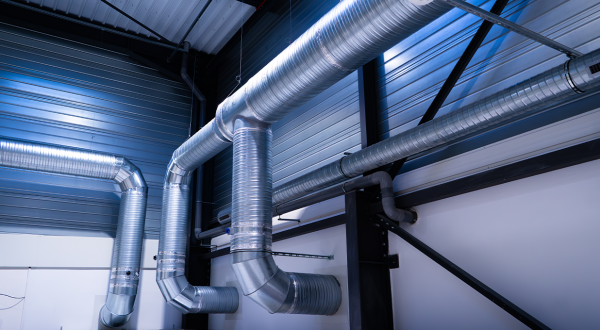
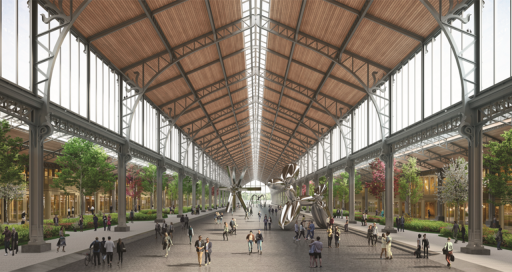
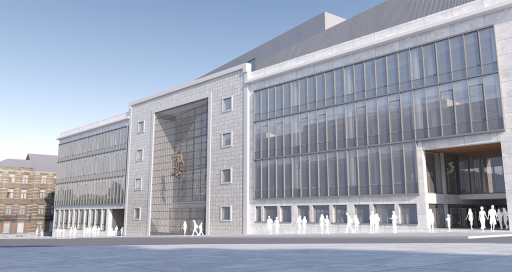
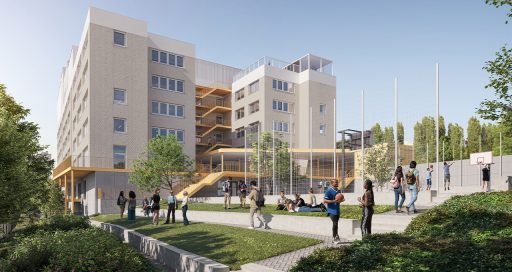
VINCI Energies Building Solutions has been seeking clarity on how the “HVAC of tomorrow” might look. With climate emergency, regulatory pressures and geopolitical uncertainty to the fore, strategies for efficient heating, ventilation and climate control in buildings increasingly require thoughtful decision-making. Fortunately, there is no shortage of hybrid approaches or low-tech solutions.
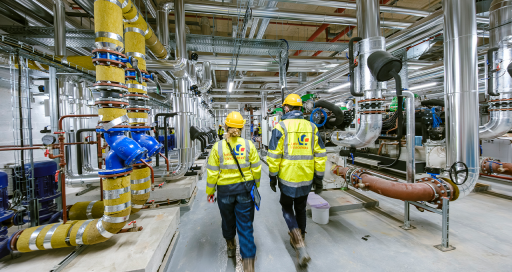
©Raphaël Soret
From facades fitted with insulation and air-handling systems to high-inertia construction materials (brick, low-carbon concrete); from reduced glass surfaces with shades and exterior blinds to high-volume interior fans; from hydraulic networks running under concrete-slab flooring to air-circulating climate ceilings…
As thermal resilience in buildings becomes a priority in the fight against greenhouse gas emissions and the pursuit of energy performance, the building sector is adopting multiple solutions to meet the need for energy-efficient infrastructure.
Building owners and operators have their sights set on polluting climate control systems that add to external heat with the hot air they discharge, intensifying the phenomenon of urban heat islands. In 2021, ADEME estimated that climate control systems were responsible for almost 5% of CO₂-equivalent emissions by the building sector in France.
Alternative cooling systems
In recent months, several top-tier tertiary sites in the Paris region – including grEEn-Campus Stellantis in Poissy (Yvelines) and the “Le Cologne” building in Rungis (Val-de-Marne) – have pivoted to more energy-efficient HVAC (heating, ventilation and climate control) techniques, enhancing their facades and interior spaces with “alternative” cooling systems.
While these initiatives undoubtedly signal the beginnings of a transformation in the sector, it still needs guidelines to take these energy-conservation efforts to the next level. That is why VINCI Energies Building Solutions, with consulting support from Impulse Partners, decided to explore what form the “HVAC of tomorrow” might take.
“This is a far-reaching qualitative study, explains Vincent Deyme, Performance Energy Manager at VINCI Energies Building Solutions, “for which we took the time to interview a number of business leaders and subject specialists within VINCI Energies, as well as experts from recognised third-party institutions such as ADEME. The aims were to perform a diagnostic of internal expectations, to map out the different technologies and potential scenarios, and to identify key market transformation dynamics along with customer and user needs.”
Michel-André Tirat, Director at VINCI Energies and coordinator of the national Climate Engineering club, adds: “In the face of changing technologies and regulations, customers need to feel supported end-to-end, from diagnostics through to systems management and maintenance, including installation and energy performance monitoring. In climate engineering, no two projects are ever the same. As integrators, we absolutely must be creative and proactive. That requires engineering competence and in-depth knowledge of the solutions and technologies.”
Ice water or direct expansion?
The VINCI Energies Building Solutions study shows that the shapes of future solutions and business activities in the realm of HVAC are strongly linked to a range of parameters: changing building stocks (with a sharp rise in problems associated with renovation); intensification of environmental pressures; evolving energy trade-offs; skills transfer; and changing customer demand. Will the technologies in use today have the same influence in the future?
“Regulations will change; the environmental emergency will intensify; geopolitical situations will remain unpredictable.”
Ice-water cooling systems offer a reliable, high-performance solution for larger buildings, especially those that are open to the public. Based on centralised cold production, this technology distributes chilled or heated water via hydraulic loops.
The other dominant technology, known as direct expansion, is present in 60% of tertiary building stock, particularly in small and medium-sized properties. It uses a thermodynamic process in which refrigerant fluid circulating in occupied areas absorbs heat from interior air in passing from its liquid state to its gaseous state in a thermal exchanger.
But as Vincent Deyme explains, the problem is that “the gases used in direct-expansion systems are under legislative scrutiny because of their global warming potential (GWP) and/or inflammability.”
A future for low-tech
In these circumstances, low-tech solutions are increasingly valued. From natural night-time cooling, free cooling, Canadian wells, Trombe walls and plant-covered buildings to optimised thermal-inertia solutions, high-performance glazing, infiltration and reflective paints, there are many tried-and-tested common-sense techniques available.
Some of the most promising passive techniques include phase-change materials incorporated into walls, floors or panels, which can store and later release heat to stabilise interior temperatures and reduce the need for active systems.
In addition to the trade-offs inherent in every building environment, the study carried out by VINCI Energies Building Solutions highlighted the importance of hybrid solutions – the more flexible the better.
“Regulations will change; the environmental emergency will intensify; geopolitical situations will remain unpredictable,” says Vincent Deyme. “In the face of all this uncertainty, one of the few things we are sure of is that we shouldn’t put all our eggs in one basket.”
07/13/2026