Initially designed to produce clean electricity, SMRs (small modular reactors) could soon be producing heat for industrial sites. The sector will need to be organised and standardised before the first installations appear in the early 2030s.
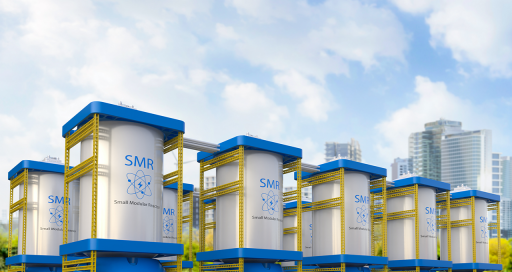
The challenges of climate change tend to play out mostly in the energy sector, where governments, established businesses, startups and research laboratories are combining their efforts to replace fossil fuels with clean, renewable sources.
“The European Commission estimates that in 2040, more than 90% of the EU’s electricity will be produced from low-carbon sources, mainly from renewable energies, backed up by nuclear energy.” To meet increasing demand for electricity, installed nuclear capacity across the EU as a whole is expected to increase from 98 GWe in 2025 to 109 GWe by 2050.
It was against this backdrop that on 10 February 2022, the French President announced the construction of six EPR2 reactors beginning in 2035, with eight more in the pipeline for 2050. The first six EPRs will be complemented by small modular reactors (SMR) and advanced modular reactors (AMR).
What is the principle behind these “small” nuclear reactors? They are more compact, more flexible, and produce less waste than conventional reactors thanks to their optimised use of fuel, but they are less powerful, best suited to areas where the demand for electricity is lower.
30 installations in Europe in 2035
How many of these new facilities are likely to appear, and when? The European Industrial Alliance on Small Modular Reactors, created recently by the European Union to facilitate and accelerate the development, feasibility assessment and rollout of these SMRs, estimates that in a “middle” scenario, Europe will have 30 installations by 2035, 80 by 2040 and 200 by 2050.
“We can reasonably suppose that the first SMRs will appear in Europe in 2031 or 2032.”
These small modular reactors are not only an alternative to coal-fired power plants, they could also in future produce heat for urban heat networks and for industry.
“The French Nuclear Energy Association (Sfen) predicts that by 2050, France will need 100 TWh of heat production to meet two major needs: industrial heat, and to a lesser extent, urban heat networks,” explains Pascal Champ, Development Director at VINCI Energies Nucléaire.
Projects all over the world
SMRs could play a key role in this. The International Atomic Energy Agency (IAEA) identifies 72 small modular reactor (SMR) and advanced modular reactor (AMR) projects worldwide, of which around 20 are being built to produce heat.
In the United States, the chemical giant Dow has signed an agreement with X‑Energy to build four high-temperature mini-reactor demonstrators. Meanwhile, China has begun to couple its Hualong pressurised-water reactors, the equivalent of our EPRs, with a high-temperature small reactor to produce industrial steam. In Finland, in 2025, Steady Energy began construction of a first SMR, which will produce urban heat for Helsinki and Kuopio.
France is not standing still either. EDF, whose NUWARD SMR project was originally devised to replace coal-fired power plants, has announced its intention to introduce nuclear cogeneration, producing electricity and heat simultaneously. Besides EDF, numerous startups are waiting in the wings (see box) with projects at varying stages of development.
Installing an industrial model
Beyond the technical challenges, the success of SMRs depends on their competitiveness. To be viable, the sector must compensate for the lost economies of scale usually derived from the large rollout of infrastructure. “This can only happen by gleaning the full benefits from mass production, standardised component production, and construction times half those of larger reactors, i.e. around four years rather than eight to ten years,” says Pascal Champ.
To meet all these prerequisites, it is imperative to align with the standards in different countries in order to standardise the certification process. Hence the need for a European-scale roadmap. “Given the progress in talks, the evident political will, and the developments under way, we can reasonably suppose that the first SMRs will appear in Europe in 2031 or 2032.”
Eight French mini-reactor projects in the pipeline
- NUWARD: EDF’s 340 MWe pressurised-water SMR operating in cogeneration to produce electricity and heat between 150 °C and 250 °C (for hydrogen, urban networks, desalination and industry).
- Calogena: 30 MWt low-pressure water reactor for urban heat networks.
- ARCHEOS: light-water thermal nuclear reactor that will supply 20 to 200 MW of power and heat at up to 150 °C – an SMR based largely on established technologies and models.
- Otrera is designing an AMR with capacity of 110 MWe and able to cogenerate 105 MW of usable heat. This AMR is based on the more mature technologies of fourth-generation sodium-cooled fast reactors.
- Stellaria is designing molten-salt fast reactors capable of producing 250 MWth and up to 120 MWe of electricity.
- Jimmy Energy: high-temperature gas-cooled AMR (HTGR) using TRISO-HALEU fuel to generate 20 MWt of industrial heat at temperatures of up to 500 °C.
- Blue Capsule: high-temperature sodium-cooled TRISO AMR (HTR) generating 150 MWt of industrial heat at more than 450 °C.
- HEXANA: dual 400 MWt sodium-cooled fast-neutron AMRs (SFR) with heat storage to supply industry or generate electricity.
03/16/2026