In order to free circularity from the residual position in which it seems to have become locked, and make it a credible and viable production model, economic organisations must accelerate the shift in their own models. And this comes with some preconditions.
It attracts significant press attention and has gathered hefty intellectual credit around it, but despite the media hype and political posturing, the circular economy has yet to take off. According to the latest report on the global circularity index from the NGO Circle Economy, it has actually declined, with its share of the global economy having shrunk from 9.1% to 7.2% between 2018 and 2023.
This fragile position relates to the complexity of implementation and the fact that the rollout of circular processes and schemes by definition requires systemic approaches. Economic organisations, particularly in high-emissions sectors such as building, must address this issue and make the shift upward in scale toward industrialisation.
Solidity is the pivotal principle of strong circularity
Agreed, but how? This question was central to proceedings at the recent Building Beyond Festival organised last May in Paris by Leonard, the VINCI Group’s future-oriented innovation platform.
To begin with, perhaps by agreeing a shared ambition. There are two forms of circular economy: weak and strong. The former involves reducing material and energy consumption, and waste generation, by optimising processes and recycling, without substantially modifying industrial frameworks.
“The strong circular economy is more systemic and future-oriented,” explains Yannick Gomez, Innovation Cell Lead at the French Alternative Energies and Atomic Energy Commission (CEA). “Its focus is a radical transformation of models for a longer product life cycle, repairing and reconditioning products. The pivotal principle of this economy is solidity.”
Solidity, or antifragility, to borrow the concept introduced by the Lebanese-American statistician and philosopher Nassim Nicholas Taleb, which describes the capability of individuals, organisations and systems not only to withstand stressors and shocks but to emerge stronger.
A business lever for the building sector
Yannick Gomez continues: “With careful management of resources, controlling raw materials and recovering them at the end of the cycle, we can make circularity a real business lever for the building sector.”
To become a business, the circular economy must rapidly gain market share from the linear economy – to go from 7.3% to 30, 40 and then 50%. Such an acceleration remains subject to a number of conditions. The first of these is the commercial relevance of the offering. Not all materials and equipment lend themselves equally to the shift toward circularity.
“The potential of each element must be assessed according to a combination of internal technical performance and external criteria (insurability, acceptability, etc.),” explains Guillaume Graffin, Logistics and Reuse Engineering Manager at VINCI Energies France – Tertiaire IDF.
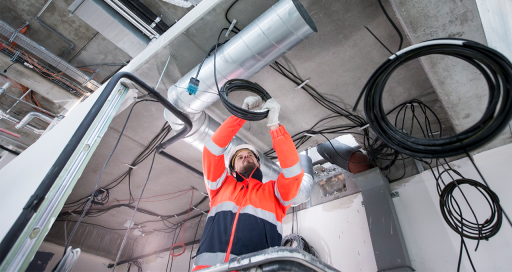
Some of the materials most available to reuse loops in a front-line sector, in the case of building, include low-voltage electrical cables. The VINCI Energies business unit Cegelec Nord Grands Projets launched Circable, a PoC based on supplying cables obtained from deconstruction. The initial objective in ramping up the pre-used solution was to instil a “reuse reflex” in orders for electrical cables within the Group.
The optional must become systematic
Another prerequisite for rolling out the circular economy is the ability of stakeholders to systematically offer a “circular option” in every commercial negotiation. This is what VINCI Construction hopes to achieve with Ogêo, an aggregate composed of primary materials (aggregate from quarrying) and secondary materials (from deconstruction, excavation and industry).
“We want to systematically and exclusively offer a product from the Ogêo range taking account of local secondary resources wherever possible,” says Blandine Revest, Materials Director at VINCI Construction France. The quantities of primary and secondary resources in the formulation of this aggregate vary case by case according to the technical and aesthetic needs of each project.
From competition to “coopetition”
To systematically offer, without imposition and to meet a need: while the principle applies to the circular economy at least as much as to the linear economy, it is not enough to facilitate industrialisation. The question is: how can we make sure one organisation’s waste is always, or almost always, a resource for another?
“We have to implement novel cooperative models,” says Raphaël Masvigner, the co-founder of Circul’R, a consultancy advising on company and regional transitions. “We need coalitions of five to ten stakeholders capable of working together to devise a precise methodology to offer precise action plans in precise fields.”
One of these initiatives is a circular economy coalition, officially launched by the French Ministry of Economics, Finance, and Industrial and Digital Sovereignty in January 2025, which brings together major manufacturers around three avenues of enquiry: identifying risks linked to the linear economy, developing effective circular economy strategies, and rolling out the identified solutions operationally. Their efforts will culminate in the publication in 2026 of an influence and action report aimed at private and public decision-makers.
“Multiplying these open loops and moving from a competitive stance to one of ‘coopetition’ is how we give ourselves the opportunity to move forward,” says Yannick Gomez from the CEA.
The prerequisites for scaling up
- Migration of underlying production and consumption models toward a functionality-based economy
- Economic acceptability of solutions, through work on pricing and managing the costs of collection, sorting, recycling and reuse
- Development of reuse platforms close to construction sites, at regional level or better
- Increased awareness of the circular economy concept among public and private contract principals and all stakeholders in the value chain
- Support from public policy and legislation (AGEC Law, extended producer responsibility principle, etc.)
- Creation of stakeholder groups to drive discussion and formalise action plans
01/15/2026