Michelin Cuneo: an effective, sustainable Logistics 4.0 model
Reading time: 4 min
At its Cuneo site in Italy, Michelin is trialling a new generation of smart logistics in which robotics meets the energy transition. Its electric AGV system, installed by VINCI Energies business unit Giordano & C – Automation., offers a glimpse into the connected, high-performance, low-carbon factory of the future.
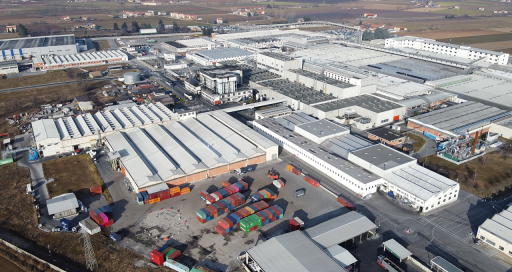
©Michelin ©Giordano
In Cuneo, in the Piedmont region of Italy, one of the Michelin’s largest European factory has become a showcase for smart logistics. In collaboration with VINCI Energies business unit Giordano & C – Automation. and Esatroll, a Swiss technological partner and supplier of automated guided vehicles (AGV), the site introduced a fleet of six fully electric AGVs to provide a 24/7 link between its production areas and logistics centre.
Automation for enhanced production
The initial objective for Michelin was to reorganise the internal tyre production flow to allow the transportation of pallets from the palletisation robots in Building 5 to logistics warehouse 5L, from which finished products are despatched to customers. The design and installation of the system by Giordano & C. took almost four years (between 2018 and 2021) due to disruption caused by the Covid‑19 pandemic.
“This type of project certainly requires significant investment, but can be made profitable in three years.”
“We designed and implemented a comprehensive system, including not only the AGVs and their management software, but also the infrastructure,” explains Marco Raimondo, Business Unit General Manager at Giordano & C. “This involved the creation of a 1.5 km reinforced-concrete track, alterations to existing buildings with new entry/exit doors, and the installation of automatic loading and unloading stations.”
Integrated smart logistics
“Each AGV is equipped with an inertial navigation system,” continues Marco Raimondo. “They learn their routes and move around autonomously between different points on the circuit.” Capable of transporting loads of up to 15 tonnes in two parallel rows of pallets, these vehicles can transfer 40,000 tyres a day, in perfect synchronisation with the production and storage systems thanks to a GPS and Wi‑Fi system. Automatic modular conveyor stations with Intralox belts ensure the continuity of flows, without human intervention, in a safe and fluid process.
Performance, safety and sustainability
By eliminating the need for conventional trucks in transfers across the Cuneo site, Michelin has reduced its CO₂ emissions by 50 tonnes a year. But the benefits go beyond the environmental: the elimination of internal heavy-goods traffic enhances operator safety; the motion-sensing system on the AGVs reduces the risk of accidents; and the automated processes ensure operational continuity even at peak times.
“The project was completed without interrupting production, a challenge we met through the gradual and perfectly controlled integration of the new technologies,” says Marco Raimondo. “The main challenge with this project was all the upstream engineering in connection with flow studies and positioning the AGVs along the route.”
A 4.0 showcase for European industry
Recognised by Michelin as a “4.0 showcase”, the Cuneo site is now a reproducible model for the international tyre group’s other factories. It demonstrates that the convergence of engineering, automation and energy transition is no industrial utopia, but a practical and profitable reality. “This type of project certainly requires significant investment, but can be made profitable in three years,” says Marco Raimondo.
The VINCI Energies business unit’s other customers should soon be able to draw inspiration from the Cuneo model. Back in 2023, Giordano & C. had already installed a similar system for a car manufacturer in one of its European factories. However, explains Marco Raimondo, “Every [industrial] site has its own constraints, and the solution must be configured accordingly.”
03/16/2026