Water: Morocco’s new strategy for tackling climate challenges
Reading time: 4 min
In response to a long-term water deficit, the Kingdom of Morocco is implementing a strategy based on desalination, water transfer and digital technology. Amine Chehlaoui, Business Unit Manager at Actemium Eau Morocco, explains how it will work.
In response to water stress that has become systemic, Morocco is accelerating the transformation of its water management model. With initiatives such as water highways, desalination plants and the digitalisation of its infrastructure, the Kingdom of Morocco hopes that by applying a combination of solutions it can secure its water supply in the long term.
The evidence speaks for itself. The country is suffering under the cumulative effects of climate change, demographic growth and economic expansion. “Morocco now faces systemic water stress,” says Amine Chehlaoui, Business Unit Manager at Actemium Eau Maroc. Repeated droughts, reduced rainfall and the overexploitation of Morocco’s water tables have rendered the historical model, largely based on dams, increasingly inadequate.
But for Amine Chehlaoui, “The real transformation doesn’t lie in the infrastructure itself. It is above all about the way water is planned for, allocated and managed to meet the country’s current and future needs.”
Rebalancing resources
In response to this new reality, Morocco is rolling out major projects, known as “water highways”, for transferring water between river basins. The principle behind these is simple, explains Amine Chehlaoui. “Water is not always available where the needs are greatest. The aim of these projects is to transport some of this resource from river basins where it is more plentiful to regions where there is a water deficit.
“To determine which resource to use and where, for what use, and under what economic and environmental conditions”
The interconnector project between the Sebou and Bouregreg basins aptly illustrates this strategy. Commissioned in 2023, it supplies the Rabat-Casablanca axis with up to 1.2 million cubic metres of water a day. “The priority aim is to securely transport water resources between regions through infrastructure designed for reliable and continuous operation,” says Amine Chehlaoui.
Desalination: the new pillar in the water mix
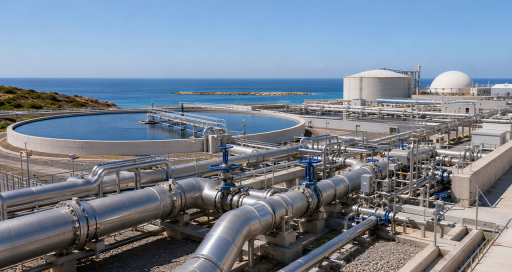
But these structures are only part of the answer. The other pillar of Morocco’s strategy is seawater desalination. “Morocco is placing great faith in desalination because it has one characteristic that few resources share – water production independent of rainfall,” explains Amine Chehlaoui. In its almost 3,500 km of coastline, the country has a major asset for developing this now-strategic resource.
Technological advances have radically reshaped the possibilities. “What was previously seen as a costly and energy-intensive solution has now become a mature, efficient technology capable of meeting large-scale needs,” says Amine Chehlaoui. Inverse-osmosis membranes, energy-recovery systems and modern monitoring tools have drastically reduced the energy required and made installations more reliable.
Amine Chehlaoui believes that desalination is destined to become “a major pillar in Morocco’s water mix”. The country hopes to increase its production capacity to nearly 1.7 billion cubic metres a year by 2030, the target being for this resource to meet close to 60% of its drinking water needs.
Digitalisation for enhanced performance
With infrastructure proliferating, the challenge now lies in managing it intelligently. “The use of data is generating effective operational tools to improve energy performance, optimise maintenance and increase equipment uptime.” Automation, remote management and monitoring systems play a decisive role in facilitating continuous operation and optimising every cubic metre produced or transported.
For Amine Chehlaoui, the next step has already been identified. “The challenge will no longer be simply to produce more water, but on an ongoing basis, to determine which resource to use and where, for what use, and under what economic and environmental conditions.” This advance will make the digitalisation and optimisation of infrastructure the keys to Moroccan water security through the climate challenges of the decades to come.
11/10/2026