Digital infrastructure: reconciling technological performance and environmental responsibility
Reading time: 4 min
Reduced emissions, responsible innovation and local commitment: at Axians and Actemium in Switzerland, climate strategy is expressed in practical, measurable actions – for future-oriented sustainable development rooted in operational realities.
In Switzerland, at Axians and Actemium, the VINCI Energies ICT and industry brands, climate and sustainable development strategy is no mere slogan or an opportunistic response to current trends. It is a fundamental pillar of our business model, along with technical performance and being close to our customers.
By 2030, VINCI is committed to considerably reducing its greenhouse gas emissions: by 40% in Scopes 1 and 2; by 20% in Scope 3.*
In a decentralised group such as VINCI Energies, this commitment is expressed in practical actions, implemented locally, measurable over time and aligned with ambitious overall targets.
In Switzerland, this involves some far-reaching decisions. We are powering more and more of our sites using renewable energies and have reduced the carbon intensity of our buildings by 52% over the past three years. Additionally, 46% of our natural gas consumption now comes from biomethane.
New sites gained in recent acquisitions pose additional challenges because they surpass our current standards. We are therefore placing special emphasis on this issue.
Mobility, innovation, circular economy
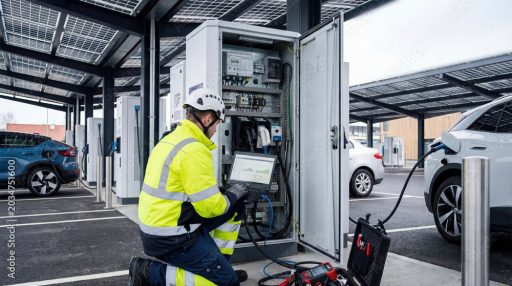
Mobility is another priority area. The electrification of our vehicle fleet is ongoing, and by 2030, two-thirds of our fleet will be electric, including 100% of passenger cars.
We are incentivising our employees by offering attractive electrified and latest-generation vehicles and encouraging the construction of private charging stations. We are also installing charging infrastructure on all our sites. For us, sustainable mobility is becoming a reality.
Reducing our Scope 3 emissions is more complex because the entire value chain is involved. We are focusing strongly on innovation and the circular economy.
An opportunity to design intelligent and sustainable infrastructure
The Green Tower developed by Axians Switzerland, a mobile phone mast that generates 40% less CO₂ over its life cycle, has already saved several hundreds of tonnes of CO₂.
Thanks to our AxiTrack solution, which gives used mobile phone components a second life, we have already been able to reuse 52 tonnes of materials and avoid the CO₂ that would have been generated in the production of new materials.
Digital solutions, such as our Collibri system for monitoring mobile phone sites, are also helping to avoid unnecessary travel and reduce emissions. These technologies are also helping our own business units and customers to reach their climate targets more quickly.
Strategic differentiation
Our next steps are clearly defined. We are involving our suppliers even more closely in our climate targets, creating offerings with added ecological value, and developing decision-support tools that enable us to measure carbon footprints from the design phase onward.
Our ambition is to reconcile economic performance, technological innovation and climate protection. We do not consider climate protection a constraint, but rather an opportunity to design intelligent and sustainable infrastructure, starting today.
*Scopes 1, 2 and 3 are categories for classifying corporate greenhouse gas emissions in accordance with the Greenhouse Gas Protocol. Scope 1 covers direct emissions from sources owned or controlled by the company (such as a vehicle fleet), Scope 2 includes indirect emissions linked to purchased energy (such as electricity), and Scope 3 covers all other indirect emissions from the value chain not already included in Scope 1 and 2 (for example, products, business travel, product end-of-life).
06/18/2026