The agricultural sector, a heavy greenhouse gas emitter, is finally tackling its energy transformation in the face of the climate emergency. Long viewed as a difficult sector to decarbonise, agriculture is now developing practical innovations for reducing its carbon footprint.
An unusual tractor appeared recently at the Derval experimental farm in Loire‑Atlantique, western France: Tractofit’Elec is the first agricultural tractor retrofitted to run on electricity and hydrogen. This prototype, created by the Vendée-based group Vensys, exemplifies a growing ambition to make agricultural machinery greener as part of the sector’s energy transition. Following field testing that began in September 2024, Tractofit’Elec was unveiled to the public in January 2025 at the Hyvolution exhibition in Paris.
This type of initiative reflects the fact that agriculture is an extremely heavy emitter of greenhouse gases. In France for example, it is the second-largest source after transport, representing 20.6% of the national total with 77 MtCO2e emitted in 2023. It is worth noting that agricultural emissions are predominantly in the form of methane (CH₄), mostly from livestock, and nitrous oxide (N₂O) from fertiliser used on cultivated soil. Any direct CO2 emissions come primarily from fuel consumption by farming machinery. This makes agriculture a special case in terms of climate action – difficult to decarbonise completely, but essential and therefore a priority for transformation.
Several levers for decarbonisation
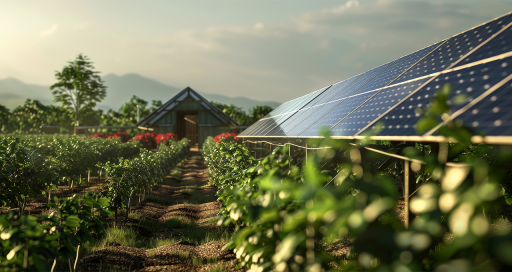
“To meet these challenges, the agricultural sector is shifting toward a systemic transformation based on several levers for decarbonisation,” explains Valentine Salomon, Innovation Market Manager at Actemium, the VINCI Energies industry brand. “These include improved energy efficiency, the electrification of farming machinery, and the adoption of alternative fuels such as hydrogen and biogas. There is also a trend toward the development of precision agriculture, using connected technologies to optimise the use of water, fertiliser and energy; the reclamation of agricultural waste via methanisation; and the integration of renewable energies, such as agrivoltaic solar.”
“The agricultural sector is shifting toward a systemic transformation.”
Businesses such as Actemium are supporting these transformations with custom technological solutions. For example, automated systems can be used to optimise irrigation or input supply, reducing emissions while increasing yields. “Actemium’s expertise also includes energy audits, via its Quick Scan Energy tool, to enhance an installation’s energy performance,” says Valentine Salomon.
From waste reclamation to water management
Waste reclamation is another business development area for Actemium. One business unit in the Actemium network, Méthalac, is developing biomass methanisation units to reclaim agricultural waste by transforming it into biogas for cogeneration, heat production, electricity generation, or injection into the natural gas network.
Meanwhile, the VINCI Energies business unit Lexem is working on the sector’s water management. On behalf of Maître Prunille, a producer of plums and dried fruit based in Agen (Lot‑et‑Garonne), it designed and installed a robotic unit for emptying palox (large crates) of fresh fruit into a water tank. Using a precision robot to empty these crates enabled the customer to reduce spillages and make water savings of 30 to 40% over the eight-week harvest period.
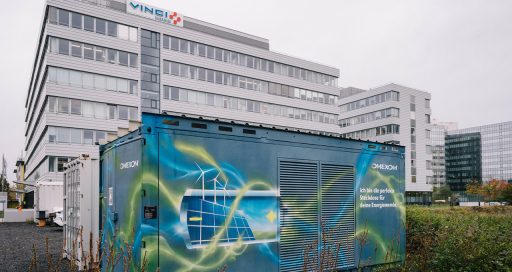
Omexom, the VINCI Energies energy brand, is doing its part with the installation of solar panels in rural settings. In 2021, in Bioule, a rural community of 1,150 inhabitants in Tarn-et-Gironde, Omexom RE Solar installed more than 30,000 solar panels over 17 hectares, which supply 13.45 MW of power. A young farmer from Bioule allocated the site to grazing for his flock of 160 sheep.
Reinventing practices, tools and production models
These approaches combine technological innovation, environmental effectiveness and profitability in a more sustainable agricultural transition. In isolation, agriculture can by its very nature never be carbon neutral, but it has a part to play, by reducing its own emissions, storing carbon, producing renewable energies and adapting to climate change.
There is no single solution for decarbonisation in the agricultural sector; it relies on a coherent set of initiatives to reinvent practices, tools and production models, with industrial and technological players leading the way to accelerate their implementation.
01/15/2026