Decarbonisation: which sectors have made the most progress?
Reading time: 11 min
The climate crisis is forcing businesses to accelerate their decarbonisation. While some business sectors are able to adapt without major difficulties, others must undergo radical transformations in order to meet these challenges. VINCI Energies is supporting numerous businesses in their trajectory of attenuation and adaptation.
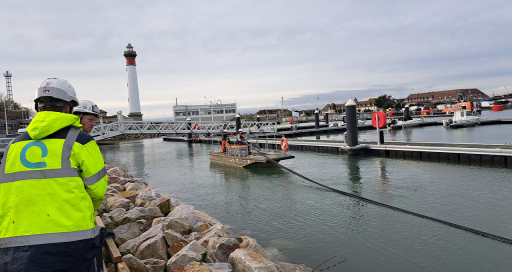
©Sabine Lemonnier-David – Seawater heating is a technology that extracts energy from surface water via an exchanger to power a heat pump for heating a building.
Against a backdrop of global climate crisis, energy volatility and fast-paced regulatory transformation, industry is feeling the pressure. Industry alone is responsible for around 25% of worldwide greenhouse gas emissions, according to International Energy Agency (IEA) figures. For manufacturers, reducing their carbon footprint is no longer a simple communication lever, but a strategic, financial and regulatory imperative.
Through its Green Deal, the European Union has set a target of carbon neutrality by 2050, along with an intermediate milestone of a 55% reduction in net emissions by 2030. Carbon taxation mechanisms such as the CBAM (Carbon Border Adjustment Mechanism) require companies to incorporate decarbonisation into their value chains. Financiers, investors, and public and private customers are increasingly demanding detailed climate plans and quantifiable results.
But not all sectors face this challenge on an equal footing. Some, including the agribusiness and automotive sectors, have accessible technical levers and the support of their end customers. Others, such as steel or cement manufacture, have to undergo disruptive transformations, often to their long-established processes.
VINCI Energies is supporting numerous manufacturers in this trajectory of attenuation and adaptation. We take a tour of some key European initiatives.
Agribusiness: Danone – the low-key champion of decarbonisation
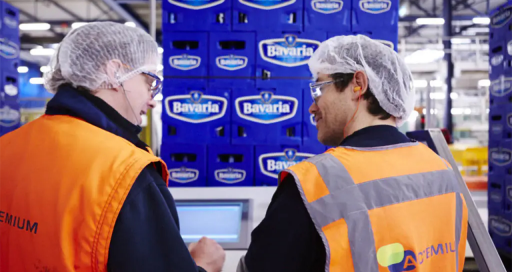
The agribusiness sector, being highly exposed to consumer and distributor expectations, has taken the initiative. In 2019, Danone launched a huge energy optimisation plan for its site in Bailleul, France, with support from Actemium.
The actions taken, and completed in 2023, include the installation of high-temperature heat pumps, waste heat recovery from discharges, intelligent management of utilities (steam, cold, compressed air), and local green electricity production using solar panels.
All this enabled the group to reduce its CO₂ emissions by 1,500 tonnes a year. These measures reduced the site’s overall energy consumption by 35% for a return on investment in less than six years.
“The agribusiness sector is feeling strong pressure from large retailers demanding low-impact products. And controlling energy costs is crucial to their often-tight margins,” explains Ali Hamdan, Environment Market Manager at Actemium. “But the transition is made easier because tried-and-tested energy efficiency solutions exist and can be implemented rapidly on these sites that consume heat and cold in large quantities.”
Chemicals: BASF electrifies its kilns
The chemicals sector is highly energy-intensive, but manufacturers are rolling out ambitious, innovation-driven strategies. On its site in Ludwigshafen, Germany, the BASF group is targeting a reduction of three million tonnes of CO₂ by 2030, thanks to a multi-lever strategy initiated in 2021, which includes the electrification of its steam-heated kilns using induction technologies, the development of partnerships for power purchase agreements (PPA), and investments in low-carbon hydrogen. Actemium is also working on BASF’s utilities management and the automation of new equipment.
“Regulatory changes in Europe (Emissions Trading System, Carbon Border Adjustment Mechanism) are imposing rapid reductions,” says Ali Hamdan. “But BASF has significant financial resources and a long-term R&D strategy to draw upon. The transformation is complex, but the group is capitalising on its capacity for innovation and large-scale industrialisation.”
Automotive: Renault moves toward zero-carbon factories
For auto manufacturers, reducing emissions is not limited to their vehicles – the factories themselves are becoming a major factor in the energy transition. “Since 2018, the Renault site in Douai, France, has transformed into a showcase for industrial decarbonisation, with 17 hectares of solar panels, green electricity supply contracts, energy-optimised processes, and its utilities converted to lower-carbon solutions,” says Ali Hamdan. Actemium helped with the digitalisation of their energy monitoring systems.
The Douai site is now more than 80% powered by renewable energies. Between 2010 and 2022, the site’s emissions fell by 75%.
Paper & cardboard: Smurfit Kappa is driven by biomass
The paper sector is unusual in that its processes inherently involve a renewable resource in the form of biomass. Smurfit Kappa has capitalised on this at its site in Nervión, Spain, where the 85 MW biomass boiler is powered by production residues, drastically reducing its dependence on natural gas. The project also included a heat recovery system and the modernisation of steam networks. Actemium also played a part in engineering the utilities. With the new equipment, the factory was able to reduce its CO₂ emissions by 250,000 tonnes a year.
“These actions offer a good return on investment, with reduced dependence on fossil energies,” says Ali Hamdan. “And this is thanks to the synergy with their industrial process, to significant internal biomass resources, and to strong experience in energy efficiency.”
Metal: a difficult decarbonisation process
Heavy, carbon-intensive and complex, the metal industry is late to the party, but on its way. Since 2021, the leading European steelmaker ArcelorMittal has been transforming its site in Dunkirk, France, into a decarbonisation laboratory with direct reduction projects using natural gas; carbon capture, utilisation and storage (CCUS); and thermal process optimisation.
This project, named “3D”, is expected to bring about a reduction of four million tonnes of CO₂ a year, almost half the site’s emissions, by 2030. Actemium is involved in modernising the utilities and automating the new production lines.
“The sector is highly dependent on coal, and the alternative technologies are expensive and insufficiently mature,” says Ali Hamdan. “Without massive public investment, the ROI is unclear. The sector is organising around pilot projects, but the scale of the investment required is hampering their rollout at massive scale.”
Carbon footprint reduction is a strategic, financial and regulatory imperative
Cement: a technological barrier to overcome
Cement production remains one of the world’s highest-emitting sectors, due to the high-temperature chemical reactions required in clinker production. On its site in Lagersdorf, Germany, the Swiss group Holcim is trialling a CO₂ capture project combined with methanol production as part of the WESTKÜSTE100 project, which aims to develop and implement a regional economy for industrial-scale hydrogen. The aim is to capture more than a million tonnes of CO₂ a year.
Research into alternative binders and the electrification of its kilns is also in progress. Actemium is working on Holcim’s process data management and on securing its energy flows.
“Clinkerisation(1) unavoidably generates emissions,” explains Ali Hamdan. “Technological solutions (CCUS, alternative binders) are in development but require large-scale investment. Government support and pressure from investors are the factors driving the industrialisation of these solutions.”
Petrochemicals: TotalEnergies and Air Liquide form a hydrogen alliance
The use of hydrogen in petrochemical and chemical applications is key to decarbonisation in this sector, which currently uses almost 100 million tonnes of hydrogen a year, all of fossil origin.
“It is imperative to replace all this hydrogen with low-carbon hydrogen produced using renewable energies, biomass or nuclear before focusing on other applications,” says Valentine Salomon, Hydrogen & Renewable Gas Market Manager at Actemium.
The alliance between TotalEnergies and Air Liquide to decarbonise refinery hydrogen in Europe is emblematic of this. The two groups are developing two major projects in the Netherlands to produce 45,000 tonnes of green hydrogen a year using renewable electricity, mostly sourced from the OranjeWind offshore wind farm. The aim is to reduce CO₂ emissions from the TotalEnergies refineries in Antwerp (Belgium) and Vlissingen (Netherlands) by up to 450,000 tonnes a year, and to decarbonise all its industrial hydrogen by 2030.
Agrochemicals: Yara produces renewable ammonia using green hydrogen
The Norwegian chemical group Yara International, which specialises in fertiliser production, opened its renewable hydrogen plant in Herøya, Norway, in 2024. Yara now produces renewable hydrogen and ammonia there, the latter for use in fertiliser production. As these processes no longer require natural gas as raw material, the site’s emissions can be reduced by 4,000 tonnes CO₂ equivalent a year.
“Renewable ammonia is an important piece of the decarbonisation puzzle, but will take time to develop at large scale,” said Yara Clean Ammonia CEO Hans‑Olav Raen when the site opened.
“With the world rapidly approaching 2030 [the date by which the European Union has mandated a reduction of at least 55% in net greenhouse gas emissions], we are also working on low-carbon ammonia to save on hydrogen and expand emerging markets for low-emissions ammonia.”
Leisure: Ouistreham experiments with seawater heating
As part of the European WaterWarmth project, cofinanced by the Interreg North Sea programme, a pilot site is currently under construction to heat the nautical activity centre in Ouistreham, France, using heat from the sea. This seawater-heating technology uses an exchanger to capture energy from surface water to feed a heat pump, which in turn heats the building.
The VINCI Energies subsidiary ELAIRGIE is designing, creating and helping to operate the installation. This experimental pilot coordinated by the BUILDERS engineering school will allow measurement of the system’s performance under real-world conditions, with tides, biological contamination and temperature variations, but also promotes new energy solutions with local sources in response to the consequences of climate change.
“This is an efficient solution, even more efficient than air-to-air heat pumps,” explains Sabine Lemonnier-David, Energy Efficiency Engineer at ELAIRGIE. “When it’s very cold outside, the seawater temperature doesn’t drop below 8 or 10 °C, while the air temperature can be below zero. Seawater heating means the heat pump’s performance is no longer impaired.”
(1) Clinkerisation is the series of high-temperature physical and chemical reactions leading to the formation of clinker, a key ingredient in cement.
12/15/2025