The Austerlitz project in Paris: symbol of a new urban fabric
Reading time: 4 min
This urban development project centred on the Gare d’Austerlitz and due be handed over in the first quarter of 2027 will promote a mix of uses while meeting new environmental standards. VINCI Energies is working on this extraordinary project with six of its business units.
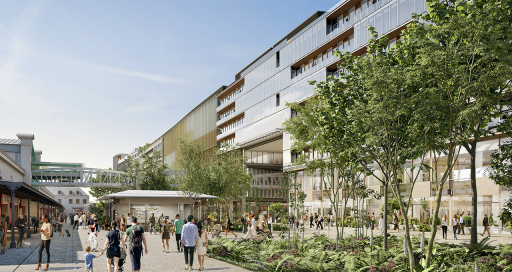
Perspectives : @L’autre image/Air image/Architectes : Atelier d’architecture Gares & Connexions, Atelier Zundel & Cristea, Dietmar Feichtinger Architectes, Henke & Schreieck, Inspace Architecture, Tank Architectes, TVK – Trevelo & Viger-Kohler, Wilmotte & Associés Architectes. Perspectives non contractuelles
Though the concept of functional hybridisation has increasingly appeared in the vocabulary of tertiary property over the years, major construction projects shaped around mixed uses are still uncommon.
This makes the Austerlitz A7A8 project within the Paris Rive Gauche ZAC (joint development zone) all the more emblematic. VINCI Construction has been entrusted with this large-scale programme backed by the developer Kaufman & Broad.
Standards and constraints
In early 2027, a new district will rise in Paris:
- 50,000 sq. metres of offices designed to accommodate the French Development Agency (AFD)
- a four-star hotel with 210 beds
- more than 220 social, affordable and student housing units
- 4,000 sq. metres of SNCF facilities
- more than 8,000 sq. metres of green space
- 16,000 sq. metres of shops open to the city
- a 426 sq. metre community centre
- a 195-seat auditorium
- a 2,300 sq. metre shared logistics platform for deliveries and waste collection
- public parking and drop-off point
- and a 3,200 sq. metre solar installation – one of the largest private solar installations in Paris.
In terms of environmental quality, the project will receive Biosourcé labelling for the choice of materials used and BiodiverCity certification thanks to its gardens and planted terraces.
The office buildings will be HQE/BREEAM certified at Excellent level. The solar panels installed on the roof of the future AFD headquarters will generate renewable energy to power the building, which will consume less energy than most other office blocks built over the past 20 years.
“This project posed a number of technical challenges, especially due to the proximity of the Seine and existing transport infrastructure,” says Marie‑Laure Canonne, Project Manager at VINCI Energies. “Maintaining continuity of service on the metro and rail lines for the entire duration of the works required some innovative solutions. For example, we had to erect a temporary 40-metre-long and 18-metre-wide structure to ensure safety during construction of the upper storeys of the bridge-building, which overhangs the Metro 5 viaduct.”
Orchestrating operations and coordinating expertise
The scale of the project and the multidisciplinary work required also posed organisational challenges.
VINCI Energies called on the expertise of six of its business units for this project: Tunzini Build’In Smart and Lefort Francheteau Eolys for the HVAC (heating, ventilation and climate control); SAGA Neo Smart for the plumbing; Phibor Espaces and Santerne Horizon for electrical engineering and fire safety; and Uxello for the sprinkler system.
“This project posed a number of technical challenges, especially due to the proximity of the Seine and existing transport infrastructure.”
“One of the unique features of this project is that it involves a consortium of five firms of architects working on behalf of Kaufman & Broad, who are also collaborating closely with the government architects,” explains Marie-Laure Canonne.
Another atypical feature is that every square metre of land had been purchased before a single drop of concrete was poured. “Everything was pre-sold through the off-plan sale scheme or a property development contract. This is an uncommon arrangement, which naturally influences the management of reporting and monitoring processes, and makes this project even more unusual,” says the project manager.
01/15/2026