The Episcopal Palace in Rodez: future tourism showcase for the Department of Aveyron
Reading time: 4 min
The Department of Aveyron has undertaken an ambitious relaunch, renovation and transformation project on this architecturally complex site. Cegelec Rodez Electricité was its selection for the electrical engineering work.
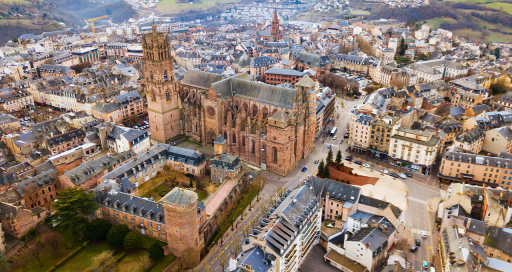
Determined to preserve and develop its historical heritage, the Department of Aveyron has launched a project to restore and renovate the Episcopal Palace in the heart of Rodez, in a bid to make it one of the region’s star attractions.
Having been closed to the public for many years, this historical site has been vacant since the bishop departed in 2016 and a project to convert the palace into a luxury hotel was abandoned. The Department of Aveyron, which owns the site, was determined both to restore the site and to give it new purpose. This architecturally complex site encompasses 4,000 sq. metres of rooms, 6,000 sq. metres of gardens and a 1,000 sq. metre internal courtyard.
Spaces to discover Aveyron’s local heritage, enjoy fine food, or simply take a stroll…
In 2025, the local authority initiated a call for tenders for the redevelopment of spaces dedicated to Aveyron and its heritage, a tour of the site’s historical treasures, a gastronomic experience, and walking trails, along with areas designed as regional innovation laboratories (e.g. for living, eating and ageing well). The palace will also be the administrative centre for the Departmental Attractions Agency.
The palace boasts rooms with 17th, 18th and 19th-century decor, some of which are listed historical monuments, to be included in the visitor experience. They will also be made available for receptions and seminars. A new contemporary space will offer an unobstructed view of Rodez and its cathedral, the surrounding countryside, and the Aubrac Plateau. The extensive restoration works will include doors and windows, roofs, facades and exterior spaces. The total contract value is €21 million, and the site is expected to open its doors to the public in early 2028.
“Complex operations relating to protection of the ancient structure and the incorporation of electrical installations into the listed buildings”
“The project, which kicked off in February 2026 and will be completed in late 2027, includes particularly complex operations relating to protection of the ancient structure and the incorporation of electrical installations into these listed buildings,” explains Alexandre Carlut, Head of Tertiary and Industrial Business at Cegelec Rodez Electricité, the VINCI Energies business unit selected for the electrical engineering works.
40 km of cables and 944 lights
Power-supply work to be completed includes functional, scenographic and accent lighting. “We are working in close collaboration with museum lighting specialists from Paris,” says Alexandre Carlut.
On the low-voltage side, Cegelec is responsible for installing all the systems required to welcome the public in the utmost comfort and safety: IT distribution, fire protection, anti-intrusion systems, and a building automation system (BAS) with centralised monitoring.
“This is a significant project for us, which requires three technicians permanently on site and three supervisors,” he adds. “In total, after two years of work, we will have installed around 40 km of cables, 900 m of suspension rails and 944 lights.”
Constraints and surprises
From walls adorned with embroidered stretched canvas in one room to stone tiling in another, from heritage parquet flooring to vaulted cellars, every space and subspace reveals its share of constraints and sometimes surprises.
“Cable runs in particular require a lengthy preliminary study phase in collaboration with the architects,” explains Alexandre Carlut. “Everything has to be identified and precisely calibrated in advance to make sure we don’t drill somewhere we shouldn’t.”
The call for tenders listed 25 different batches. One of the operational difficulties is the coordination of numerous trades working simultaneously in extremely diverse spaces, often with significant constraints. As Alexandre Carlut explains, “The palace has several wings, each featuring different shapes, spaces and materials. The arrangement was to proceed wing by wing, which is undoubtedly drawing out the project, but does ensure maximum caution.”
06/18/2026