Collective self-consumption loops are local energy-sharing solutions with considerable long-term benefits, particularly in terms of energy price stability and obtaining energy from renewable sources. Citeos Montpellier and Eurovia Languedoc Roussillon are offering VINCI business units a model to help them develop these solutions.
From the initial pilot schemes launched in 2018, collective self-consumption (CSC) loops have multiplied across France. Conceived in response to climate change, energy transition challenges and volatile electricity prices, these local energy-sharing loops between suppliers and consumers are doubling in number year on year. There are now over a thousand active installations nationally, with around 1,300 more in the design phase.
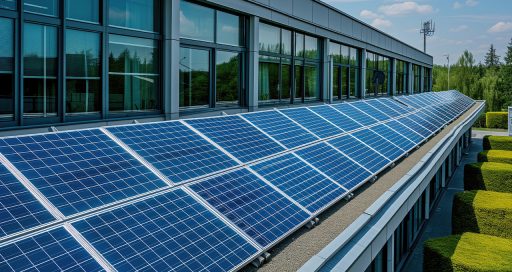
But how exactly do they work? CSC enables public and private stakeholders in a given area to share in renewable energy production, most often solar, via the public distribution network.
As defined in the legislation (Articles L315‑1 et seq. of the French Energy Code), this mechanism requires a number of constraints. Partners in the scheme must be represented in a dedicated legal entity, which enters an agreement with the power grid operator (Enedis or a local distributor). The distance separating the two participants furthest from each other must be less than 2 km in an urban environment, 10 km in a suburban setting, and 20 km in a rural area, and the combined power of all production facilities must not exceed 5 MWc.
Wide-ranging prospects
“CSC is set to become an increasingly significant electricity consumption model, particularly as state financial support for solar is reduced,” says Frédéric Petitbois, Director at VINCI Energies France, of a CSC demonstrator between Citeos Montpellier and Eurovia Languedoc Roussillon. “The number of stakeholders involved (specialist engineering consultants, software solutions providers, citizen collectives) is growing rapidly. VINCI needed to take the lead in this ecosystem.”
The partners in a loop all share one primary objective: to reduce their energy bills. Partner A, who consumes energy for their own needs and has a surplus, can resell this to a Partner B under a contractual tariff agreed between the two parties.
“Collective self-consumption is now a well-established model”
But beyond the economic considerations, collective self-consumption offers a wide range of prospects: an increase in available renewable energy and added regional benefits from enhanced energy autonomy, local stakeholder involvement, etc.
Ultimately, CSC offers decentralised and resilient renewable energy production by aggregating many small local production sources. It does require significant initial investment, but offers major long-term benefits, particularly in terms of energy price stability and reduced dependence on fossil energies.
A replicable model
Creating a CSC loop requires considerable technical engineering (diagnostics, simulation), legal engineering (setting up the dedicated legal entity) and social engineering (public consultation). “Because they involve many different stakeholders, these loops can be complex to set up, requiring expert support,” explains Frédéric Petitbois. “It’s a question of assessing the economic, technical and legal aspects to precisely evaluate the investment costs and how much energy might be produced, and to optimise self-consumption within the loop through an appropriate choice of consumers.”
To be able to offer its business units a replicable, scalable model, the VINCI Group set up a demonstrator between Citeos Montpellier and Eurovia Languedoc Roussillon in the Montpellier area, which is currently in operation.
Reflections and working hypotheses have been pushed to the limits to ensure full understanding of the administrative and legal constraints, and to test all accounting and production/consumption scenarios.
“We’ve worked on standardising the contractual package and developed tools to simplify and scale up the model, so we are now in a position to provide Group business units with an operational deliverable for all eventualities,” explains Frédéric Petitbois. “The legal framework we’ve created can even agglomerate projects not physically located in our territory.” The solution is soon be rolled out between six or seven VINCI entities in a business zone in Vitrolles (Bouches‑du‑Rhône), not far from Marseille.
07/20/2026