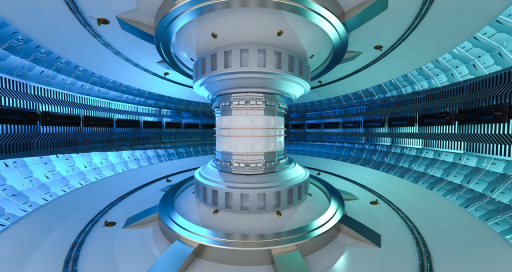
To reproduce nuclear fusion – which occurs naturally at the heart of the Sun – at industrial scale to generate safe, abundant, non-polluting energy: this is the goal the French agencies CNRS and CEA, together with the startup GenF, have set with their Taranis project. Nuclear fusion offers major benefits: energy capacity four times greater than from fission, zero CO₂ emissions and very little waste. Fusion works by combining nuclei of deuterium and tritium, two isotopes of hydrogen found on Earth in massive quantities. The problem is that these two particles are both positively charged and naturally repel one another. To overcome this electrostatic repulsion and fuse the two nuclei, it is necessary to reach and maintain temperatures in the order of 100 million degrees Celsius. This, in a nutshell, is the aim of the Taranis project: to create a demonstrator inertial-confinement nuclear fusion reactor capable of generating more energy than it uses to attain these high temperatures. The consortium hopes to begin producing energy in quantity by 2040 and to move to scale by 2050.
09/10/2026
Learn more:
cnrs.fr