The renovation of this iconic French heritage site, unveiled at the Paris 2024 Olympic and Paralympic Games, was the result of a massive and complex project, with many technical batches entrusted to VINCI Energies business units. It was a real challenge of organisation and adaptation.
©Raphaël Soret
It was a titanic project that took shape between 2022 and 2025 in the heart of Paris: the renovation of the Grand Palais, one of the City of Light’s most iconic heritage buildings. The project owner – Réunion des musées nationaux (RMN) – had a double objective: to host the Paris 2024 Olympic and Paralympic Games under Europe’s largest glass roof, and to modernise the facilities to start a new page in the history of this monument more than a century old.
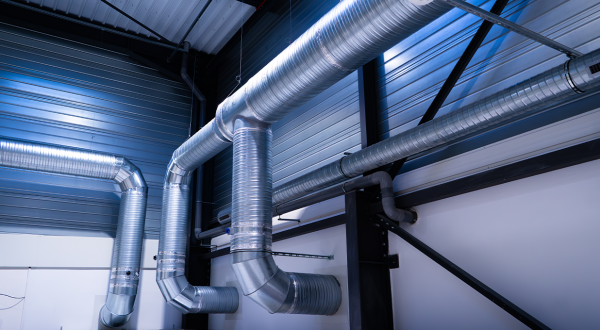
Two groups of VINCI Energies business units were assigned to technical batches worth more than €54 million. The plans included a complete overhaul of the electrical systems, installation of a Category-A fire safety system with thermal cameras, and renovation of the heating, ventilation and climate control (HVAC) equipment. All these installations are connected to a building automation system and hypervisor covering the site’s three buildings, which occupy a total of 72,000 sq. metres.
Four business units were involved: Cegelec Tertiaire IDF and Saga Tertiaire for the HVAC and plumbing batch, and Phibor Entreprises and Citeos Grands Projets en IDF for the power supply and extra-low voltage batches and architectural lighting. The 400 or so people working for these business units installed 50 km of cable trays, 2,000 km of cables, 200 electrical cells and cabinets, 125 computing racks, and thousands of terminals, not to mention 35 km of mains power and sanitation networks.
112 sub-areas and 86 project batches
“This isn’t the biggest project we’ve ever worked on, but it is the most complex,” says Patrick Pulcrano, Project Director at VINCI Energies, who has worked on massive projects from the DUO Towers in Paris to Paris La Défense Arena in Nanterre (Hauts-de-Seine). The logistical challenges of the project – whose location beside the Seine in arguably the most prestigious district in Paris made plant supply particularly difficult – were only heightened by the complex phasing and organisation required. Concurrent working on each operational plot was extremely intense in a building divided into 112 works sub-areas.
“The project was divided into 86 batches, for the most part managed directly with the contractor. We had to work in fragmented spaces packed with dozens of different entities and trades,” recalls Mathieu Juin, Business Unit General Manager at Citeos Grands Projets en IDF, which was responsible for the monument’s architectural lighting.
“This isn’t the biggest project we’ve ever worked on, but it is the most complex.”
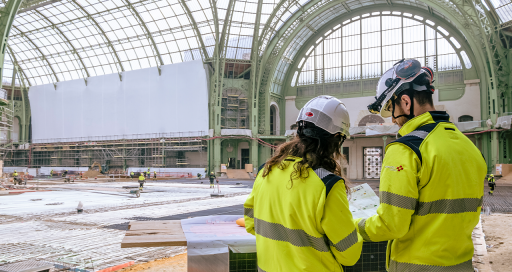
At peak times, up to 1,000 people were working on the Grand Palais site, including 400 from the VINCI Energies teams alone. The use of BIM (building information modelling) may have simplified the modelling of interactions between trades and resolved spatial conflicts between the different batches, but the teams constantly had to adapt to constraints that emerged as features were demolished or uncovered. “We had almost 700 technical change requests. For every one, we had to find solutions with the least possible impact on the various activities in progress to make them compatible with our execution deadline,” explains Patrick Pulcrano.
The stock-management conundrum
In this hive of activity subject to so many modifications, stock management became a recurrent puzzle. “Just for our lighting batch, we had to install over 70 different luminaire parts with different optics, sizes and trims. The slightest modification meant reviewing the parts list and amending our stocks of lighting terminals,” says Mathieu Juin.
Around 2.3 km of museum lighting rails were installed in the exhibition galleries to provide adaptable event lighting, and Citeos pulled more than 140 km of cables. “We studded the whole site with 10,000 light points,” he adds. “At each stage, we had to consider the building’s architecture as a whole while enhancing each individual space.”
Great ability to adapt
To renovate technical facilities in a listed monument like the Grand Palais requires a powerful ability to adapt. The teams from Phibor, who were responsible for routing major amenities, certainly experienced this. As works progressed, facing an accumulation of obstacles to the point where further progress would not be possible, they proposed burying most of the high-voltage loop, which was initially designed to use overhead lines throughout.
Over the course of the project, the Grand Palais revealed its share of technical quirks, but also previously undiscovered archaeological gems, requiring the teams to bring all their agility and ingenuity to bear to deliver the project on time. Their achievement earned the VINCI Energies teams a decoration from the Ministry of Culture – the title of Chevalier de l’Ordre des Arts et des Lettres.
Key Figures
72,000 sq. metres occupied by the three buildings on the Grand Palais site
4 VINCI Energies business units mobilised, working amid 86 batches in 112 sub-areas.
Up to 1,000 people working under the PIC national citizenship scheme, including 400 from the VINCI Energies teams alone.
2,000 km of cables, 50 km of cable trays, 200 electrical cells and cabinets, 125 computing racks
700 technical change requests received during the project
06/18/2026