Industry is set to undergo a major transformation with the emergence of Physical AI, which is redefining the possibilities of automation and opening the way to smarter, more flexible and more resilient factories. Integrators such as Actemium, capable of transforming technological innovations into real-world industrial solutions, have a leading role to play in this breakthrough.
In conventional robotics, robots execute predefined, repetitive tasks in stable, structured environments. Advanced robotics, stimulated by advances in computer vision in the 2010s, gave robots greater autonomy and enhanced perception of their environment with the integration of advanced sensors and artificial-intelligence algorithms. But their behaviours remained largely preprogrammed.
Adaptable robotics marks a new technological leap in allowing robots to modify their behaviour in real time when confronted with dynamic environments or unexpected situations. Thanks to learning algorithms that reduce their dependence on explicit programming, for example through reinforcement and imitation learning, these systems interpret their situation and modify their actions accordingly, offering real flexibility gains.
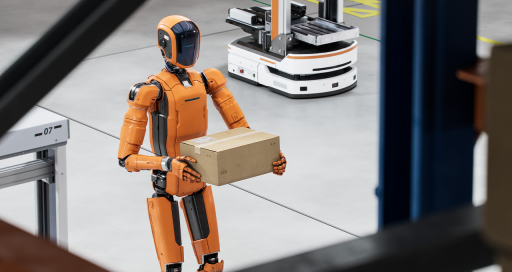
These advances are laying the groundwork for Physical AI, which combines cognition, adaptation and action. “The concept of Physical AI describes embodied artificial intelligence capable of acting autonomously in the real world. We also refer to operational AI agents,” explains Frédéric Boulvert, Innovation, Automation and Advanced Robotics Business Engineer at Actemium, the VINCI Energies industry brand.
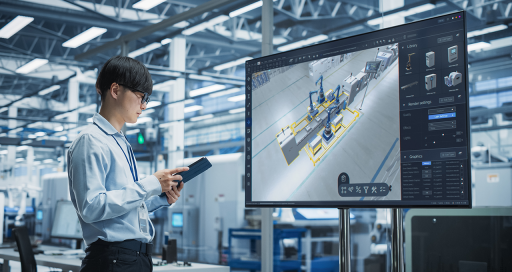
“These systems operate according to a perceive-decide-act cycle, with continuous learning.” Sensors and computer vision provide the perception; reinforcement learning and human demonstrations guide the action; digital twins are used to simulate real environments, generate synthetic data and optimise behaviour prior to rollout. Robots in various forms equipped with adaptable actuators then precisely execute the actions.
Is Physical AI a reality?
So much for the theory. In practice, Physical AI is attracting growing interest, but actual rollout remains limited. In the field, automation tends to be hybrid, with conventional robotics, advanced automation and the basic elements of Physical AI all coexisting. “Investment announcements are everywhere,” says Frédéric Boulvert. “Hyundai, for example, is planning to gradually integrate humanoid robots into its production lines from 2028.”
While the majority of projects are still in the pilot phase, some are already showing a high level of maturity: Fanuc’s lights-out (dark factory) production facility in Japan is almost entirely self-operating, and in China, CATL is using humanoid robots to connect high-voltage batteries on its assembly lines.
“Embodied artificial intelligence capable of acting autonomously in the real world”
Strategies vary between regions. In Asia, robotics is compensating for labour shortages. In Europe, the European Commission is promoting Industry 5.0, which builds processes to be human-centric, sustainable and resilient: in other words, robotics is an assistive tool, which automates repetitive and arduous tasks while keeping human beings at the centre of decision-making.
“We are seeing a gradual shift from deterministic advanced robotics toward adaptable robotics, where systems can adjust their own behaviour without major reprogramming,” says Frédéric Boulvert. “But the sense of touch remains a major technological hurdle. Handling differently shaped, soft or fragile objects with human levels of dexterity is a challenge.”
Actemium and its robots
In this radically changing landscape, Actemium is helping manufacturers design, implement and optimise robotics systems that are reliable, effective, sustainable, and can adapt to sectoral needs and real-world conditions.
As an integrator, Actemium has for many years been investing in advanced robotics for a variety of use cases: picking solutions for mixed parts, automated quality control, assembly, palletisation, packing, and self-navigating mobile robots. Its recent projects include: a collaborative robot for mixing pastry recipes; flexible, mobile end-of-line robots; and a humanoid robot designed to perform complex assembly of electronic components. AI-enabled robotic picking POCs or demonstrators are also in the pipeline, opening up new prospects in agrifood and logistics, where the sheer variability of items is still a barrier to automation.
Actemium is also preparing for the future with adaptable robotics and Physical AI. The VINCI Energies industry brand is collaborating with AICA, using its AICA Studio solution to develop programming methods better suited to more flexible and scalable use cases. “Will this make it possible to optimise existing systems or create new activities by robotising processes that hadn’t been previously?” wonders Frédéric Boulvert. Today, Actemium’s three main areas of expertise are industrial robotics, special-purpose machines and mobile robotics. Adaptable robotics may soon become a fourth strategic business line.
Guided by its in-house Robotics Club’s advanced robotics working group, Actemium’s vision is based on the three pillars of Robotics 5.0: a human-centric approach, sustainability and resilience. Its strategic roadmap aims to identify market needs, to ensure technological accountability and share knowledge, to develop new use cases, and to stay abreast of evolving safety standards and concerns.
06/18/2026