Spain: a solar funicular helping to make mobility more sustainable
Reading time: 3 min
The Artxanda Funicular in Bilbao has become a unique energy innovation laboratory with photovoltaic solar modules incorporated directly into the track – in a first for Spain.
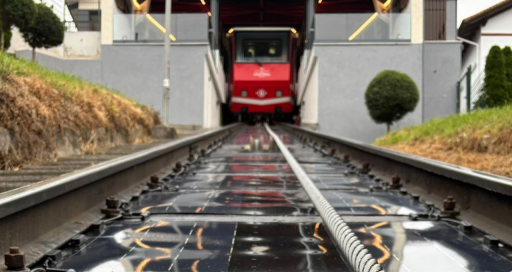
The city of Bilbao has taken another step closer to carbon neutrality. In August 2025, the city council opened an innovative solar installation on the Artxanda Funicular, the result of a call for tenders won by Omexom through its company Tecuni, a subsidiary of VINCI Energies Spain. This pilot project, worth over €73,000 and completed over a four-month period, joins the roll of unusual solar installations with the aim of showing that it is possible to produce renewable energy without impacting the urban landscape or the safety of infrastructure.
In addition to the solar panels installed on the station roof and on the foundations of a bridge carrying the funicular, additional composite solar modules were positioned between the rails along 25 metres of track, for an installed capacity of 2.7 kWp. These panels, designed by the Basque company Izpitek, use high-yield N-type cells, which are able to withstand the site’s mechanical and climatic stresses.
Safety and continuity
The electricity produced is injected into the funicular network, providing around 71 MWh, or almost 70% of its annual consumption. For Celestino Gómez Paez, Project Manager at Omexom in territories business line, “This initiative confirms our commitment to implementing sustainable energy solutions that offer an innovative response to the needs of the community and its environment.”
“The Artxanda experience represents tangible progress in the energy transition”
One of the biggest challenges with this project was to ensure safety and service continuity. “We had to confirm with the funicular technicians that the installation would not cause any operational problems,” says Celestino Gómez Paez. Another challenge was finding a manufacturer capable of designing customised modules that would fit into the limited space between the rails and supports. “The client was very interested in this installation, which was not included in the initial plan.”
Innovation and transition
This system is a perfect fit for Bilbao’s energy efficiency strategy to reduce the carbon footprint of public transport while optimising every square metre of available space. Our approach means that no additional space has been artificialised – the energy production is embedded in existing infrastructure.
The Artxanda project illustrates – symbolically and in reality – the convergence between technological innovation and urban transition. The integrated solar modules open up the prospect of new forms of decentralised self-consumption, which will be essential to achieving the targets in the 2024/1275 European Directive, which stipulates zero-emissions public buildings from 2028 onward.
For Celestino Gómez Paez, the Artxanda experience represents “tangible progress in the energy transition” and will be a point of reference for future infrastructure projects in Spain. With this project, the Basque capital is showing that historical public transport can be a model of sustainability, combining technology with visual appeal and respect for the environment.
Following on from this success, Tecuni is already testing self-supporting vertical modules and pedestrian solar installations, confirming the Spanish city as a powerhouse in innovation for clean energy.
04/16/2026