Ecological infrastructure: a key tool for regional transformation
Reading time: 6 min
With urbanisation and light pollution increasing, local authorities are turning to green, blue and “dark” infrastructure to re-establish natural networks. These terrestrial, aquatic and nocturnal networks allow different species to move around and adapt to climate change. We examine local examples and innovations with Citeos.
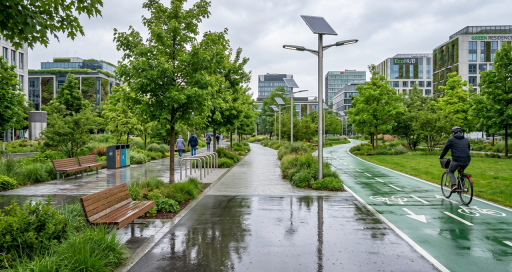
With many local authorities in France asking themselves how best to reconcile urban development, biodiversity and low-intensity lighting, recent debates about light pollution and soil artificialisation have thrust ecological infrastructure back into the limelight.
Green, blue and dark corridors play a key role in restoring ecological networks weakened by urbanisation, infrastructure and the fragmentation of natural habitats.
Restoring ecological networks
Ecological infrastructure is a continuous network of habitats that allows different species to move around, feed, reproduce and adapt to environmental change in increasingly human-dominated territories.
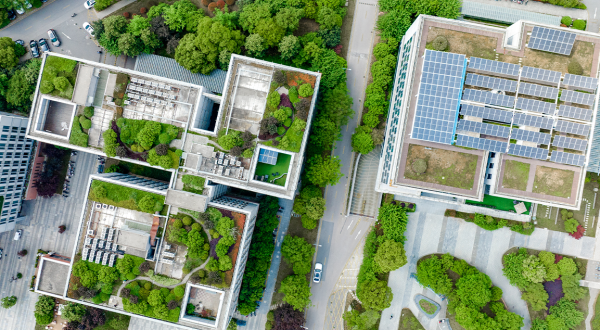
Green infrastructure consists of land areas that favour biodiversity -forests, hedges, fields, wild land, parks and ecological corridors- and maintain continuity between habitats. It enables numerous plant and animal species to move around, reduces population isolation and is a direct defence against soil artificialisation. Restoring hedgerows, linking urban parks and conserving wild land are all actions that can help get nature moving.
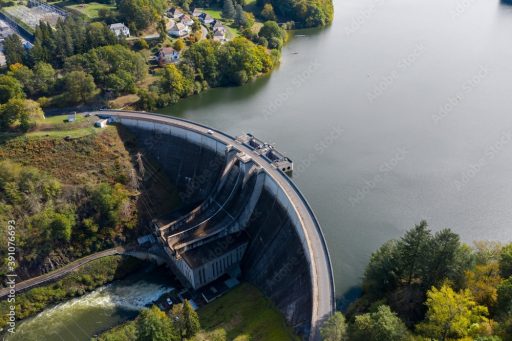
Blue infrastructure refers to aquatic environments: watercourses, wetlands, shorelines and riverine forests. Disrupted by dams, altered by river channelling and damaged by pollution, these habitats require careful management to ensure the free movement of fish, sediment and water-dependent species in general. Renaturalising riverbanks, restoring a pond or creating a fish ladder are some of the initiatives introduced to reconnect these often profoundly altered environments.
More recently, and increasingly reflected in local policies, dark infrastructure is a response to the long-underestimated phenomenon of light pollution. Excessive artificial light seriously disrupts nocturnal species such as bats, insects, amphibians and birds, often affecting the way they move around, reproduce and hunt. Establishing dark infrastructure involves recreating dark corridors, redesigning public lighting and maintaining total blackout zones to restore the darkness essential to fully functional ecosystems. Reducing light intensity, aiming lights toward the ground and automatically switching lighting off at night are some of the operational solutions that authorities are adopting.
A tool for adjusting to climate change
These three ecological infrastructure networks are part of a comprehensive vision informed by the National Green and Blue Infrastructure Policy enshrined in the Environmental Code. Together they are a tool for adjusting to climate change by allowing species to migrate to more suitable areas, and are incorporated into local planning: regional ecological coherence schemes, local urbanism plans, the national biodiversity strategy, and European directives such as Natura 2000.
An essential element in resilience to climate and environmental crisis.
Beyond the regulatory framework, these infrastructure networks encourage more comprehensive regional restructuring: linking rather than fragmenting; cleaning up rather than channelling; making environments darker when biodiversity requires it. They also open the way for local authorities to launch practical projects, often in partnership with specialist technical entities.
Solid expertise from Citeos
A VINCI Energies subsidiary specialising in solutions for energy performance, low-carbon mobility, and enhancing and protecting urban spaces, Citeos has developed solid experience in this area. “Dark infrastructure has only recently become a talking point, but Citeos has been working on this for 10 years,” says Antoine Gilmant, General Manager at Citeos Ingénierie Nord.
In 2024, based on its wealth of experience, Citeos developed a tool to help VINCI Energies business units to identify dark corridors on sites where they are working by aggregating data from the Somme department’s ecological zones to create a map, which allows Citeos to identify and create ecological corridors and networks.
“This tool comes with a catalogue of solutions to be applied where applicable -orange lighting, presence sensors, anti-glare barn doors to direct light, lights fixed closer to the ground, etc.- and has also been developed for the Oise and Aisne departments, and soon for Nord and Pas‑de‑Calais,” explains Antione Gilmant.
Completed regional projects
Citeos is strongly focused on meeting the requirements of local authorities. Two of the successful collaborations in 2025 were with the communes of Faches‑Thumesnil -Nord department- and Blache‑Saint‑Vaast -Pas‑de‑Calais-.
Having declared an ecological emergency, Faches‑Thumesnil called in Citeos to overhaul its lighting and to map dark infrastructure across its territory. “Based on this work,” says Antoine Gilmant, “we recommended orange lighting, presence sensors, barn doors to direct light, and night-time switch-offs in blue, green and dark zones, and in the ecological corridors we created to link up this infrastructure.”
For Blache‑Saint‑Vaast, Citeos installed several of the solutions mentioned above in a bid to safeguard marshlands affected by development.
To accelerate the reintroduction of ecological networks across urban and rural landscapes, Citeos needed to measure the impact of the solutions implemented. “We sourced ultrasonic sensors capable of detecting more than 80 animal species in the managed areas,” explains Antoine Gilmant. He also wants to forge a partnership with the University of Lille to promote academic research into light pollution.
Citeos is convinced that biodiversity is more than “food for the soul” – it is the living foundation of these regions and an essential element in resilience to climate and environmental crisis.
05/20/2026