New strategies are emerging to mitigate the losses linked to the transmission of electricity from offshore wind: offshore hydrogen production, the establishment of coastal industries and conversion to heat. These solutions promise to reduce costs, stabilise networks and revitalise regions.
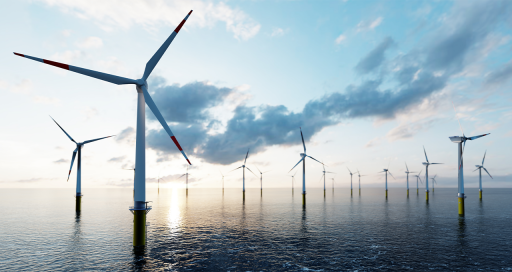
Integrating energy from offshore wind into national electricity networks is one of the major challenges posed by the energy transition. Offshore wind farms generate substantial quantities of electricity, which has to be transmitted over long distances to energy consumption centres. Notwithstanding the progress made in high-voltage direct current, these transfers come with heavy losses, often dissipated in the form of heat. These losses reduce efficiency across the supply chain and increase costs.
Using the electricity directly in situ for coastal industries, hydrogen production or to supply heat networks would go a long way toward addressing the problem.
Option 1: directly produce hydrogen offshore
The “Power‑to‑X” strategy involves the transformation of renewable electricity into another energy vector. In the case of offshore wind, this can mean producing green hydrogen from water electrolysis to avoid the losses inherent in electricity transmission. Alkaline electrolysers (AEL) are an economical and proven solution, proton-exchange membranes (PEM) are more flexible and can adapt to variable wind conditions, and high-temperature solid oxide electrolyser cells (SOEC) offer superior yields thanks to the use of residual heat.
One challenge here lies in making installations resistant to extreme maritime conditions – corrosion, airborne salt, waves, etc. The water must be desalinated to obtain the purity needed for electrolysis, in a process that itself consumes energy. The hydrogen produced can then be stored in pressurised containers, liquefied at minus 253 °C to increase its energy density, or transported though dedicated pipelines.
Option 2: bring industry closer to offshore wind farms
Another solution consists in establishing highly energy-intensive industries directly on the coastline. Chemical plants, steelworks and data centres could use electricity from offshore wind without the long-distance transmission, and with the added benefit of stable, competitively priced power.
“The future of offshore wind lies in its intelligent integration into energy systems
An iconic example of this is the third Northvolt gigafactory, currently planned and under development on the North Sea coast of Germany. This highly automated battery factory will be powered using local wind energy to produce batteries with an extremely small carbon footprint.
The coastal location offers several advantages: reduced CO₂ emissions, lower logistical costs due to the proximity of raw materials and ports, the creation of skilled jobs, and a boost to the region’s economy. It also allows surplus electricity to be absorbed when winds are stronger and reduces the need for heavy transport infrastructure.
Option 3: convert the electricity into heat
“Power-to-Heat” technology offers a third possibility. This involves transforming surplus electricity into heat, which is then injected into urban heat networks. In Neubrandenburg, VINCI Energies has installed three 10 MW electrode boilers in the local gas and steam turbine generation facility. Surplus electricity from wind production is used to heat water for supply direct to the urban network or storage in a heat accumulator.
This flexibility makes it possible to avoid overloading the power supply network, to provide continuous heating, and to reduce fossil fuel consumption and CO₂ emissions. It perfectly illustrates the added value of combining the electricity and heat sectors.
The benefits of using offshore wind power directly are numerous:
- Significant reduction in the losses inherent in long-distance transmission.
- Improved efficiency thanks to local consumption and a minimum of energy conversions.
- Reduced pressure on interregional networks, with less congestion and more stability.
- Lower costs due to simplified infrastructure and optimised energy use.
- Enhanced safety through the storage, flexibility and use of hydrogen.
- Development in coastal regions with the establishment of industries and creation of skilled jobs.
The future of offshore wind lies in its intelligent integration into energy systems. Offshore hydrogen production, energy-intensive industries sited on the coast and the conversion of surplus electricity into heat are some of the solutions for reducing losses, lowering costs and ensuring a reliable power supply. These strategies also enhance the sustainability of industrial production and sustain regional competitiveness. Using electricity where it is generated transforms offshore wind into a powerful driver of the energy transition.
05/20/2026