In response to the periodic saturation of its power supply network, Portugal is turning to storage to support the increase in solar power production. East of Lisbon, a new battery storage project encapsulates this new strategy, combining energy hybridisation with enhanced network resilience. And Omexom is at the helm.
©Cyrille Dupont / The Pulses
As Portugal accelerates its energy transition, the question of storage remains central. With more than 6 GW of solar already installed and production expected to triple by 2030, the country is facing a paradox: the boom in renewables is causing periodic saturation of the network, often in the middle of the day or at weekends.
This was the context in which Hyperion, the Portuguese renewable energy specialist, entrusted Omexom with the creation of a 10 MW / 40 MWh battery energy storage system (BESS) on the Cavaleira site in Estremoz, to the east of Lisbon. The project is in receipt of RRF (Recovery and Resilience Facility) finance under the EU’s NextGenerationEU plan, which aims to promote the hybridisation of renewables installations.
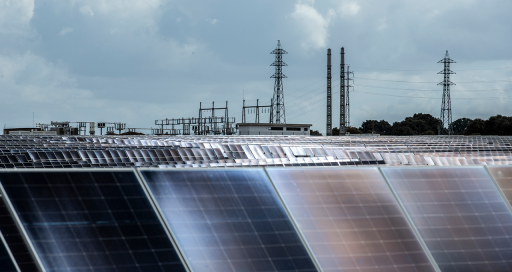
Omexom Portugal is already responsible for construction of the 51.8 MW solar power plant and was selected for this project in summer 2025 based on its engineering expertise and the quality of its previous projects. “Winning this project was due to the customer’s satisfaction with our adherence to deadlines and the performance our teams showed,” explains Luís Silva, Business Unit General Manager at Omexom Renewables Portugal. The power plant, located in an area that enjoys 2,000 hours of sunshine a year, will produce approximately 104 GWh a year, to be injected into the national grid.
Enhancing reliability in the electrical system
Battery storage will play an essential role in absorbing surplus energy when production exceeds consumption or prices fall too low. “The more solar power plants we build, the more they contribute to enhance the complexity to manage the Grid,” says Luís Silva. The BESS will help smooth out variations, reduce losses and improve the reliability of Portugal’s electrical system. It will also make more effective use of the energy produced, supplying it when demand increases, particularly in the evening.
“ The Client´s aim is to maximise the authorised injection point by combining solar energy by day with wind power at night, with the BESS as a balancing mechanism”
Cavaleira is also a perfect example of hybridisation. Hyperion is also developing a wind farm on the same site. “The Client´s aim is to maximise the authorised injection point by combining solar energy by day with wind power at night, with the BESS as a balancing mechanism,” explains Luís Silva.
Commissioning in Q2 2026
On the ground, Omexom is managing all civil engineering works, the installation of auxiliary equipment, cabling, and the connection to the transformer station, and is also supplying SCADA and PPC systems. The project also enjoys operational support from Omexom Conversion & Storage in France. “Their expertise helps us to nail down the technical and contractual aspects, which are so crucial for a first BESS project,” says Luís Silva. Commissioning is planned for May or June 2026, with full handover expected in Q3.
06/18/2026