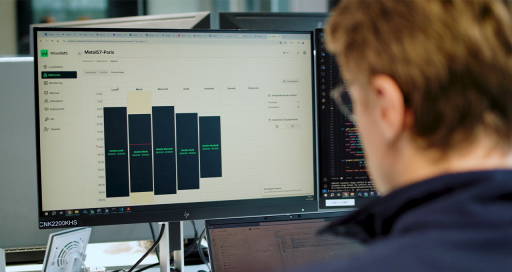
The genetic sequencing data interpretation portal DIAGHO, developed by the university hospitals in Rennes and Nantes, was implemented with support from Axians. This cutting-edge initiative confirms France’s position in an international genetic medicine ecosystem.
In the 1990s, it took anything from three to ten years of international research to identify the gene responsible for a condition such as cystic fibrosis. Today, thanks to huge advances in genome research, geneticists and patients with cancer or rare conditions may find hope in genetic sequencing.
By making it possible to read and decode an individual’s entire genome, this method opens up unprecedented prospects in personalised medicine and treatments tailored to individual genetic profiles.
Though France is one of the first countries to incorporate DNA sequencing clinically at national level (see box), the international medical community is focused on cooperating to advance knowledge and practice in what remains an extremely complex sphere.
Collaborative approach
This collaborative approach allowed the rapid development of DIAGHO, an assisted-diagnosis platform for rare conditions that uses high-throughput sequencing data (Next-generation Sequencing, or NGS), which can read and filter tens of thousands, even millions, of genetic variations in patients’ DNA or RNA molecules.
The project was given the green light in 2019 from the cooperative healthcare group Hôpitaux Universitaires du Grand Ouest (GCS HUGO), which includes six major hospitals in Brittany, Pays de la Loire, and Centre-Val de Loire, along with the Cancer Institute of Western France, and two hospitals in Le Mans and Vendée.
A non-prescriptive, platform-independent solution that allows each laboratory to apply it alongside their own methods.
One of the group’s challenges lay in making DIAGHO a sovereign entity and keeping the control of medical data subject to public governance by ruling out any external cloud hosting.
From an operational perspective, the project was principally driven by the university hospitals in Rennes and Nantes – the former recognised for its expertise in bioinformatics, and the latter a certified “healthcare data hosting provider” – with the IT expertise to lead the other establishments.
“In 2022,” says Cédric Quillévéré, Senior Datacentre Architect at Nantes Hospital, “our executive management tasked us with responding to a call for tenders for implementation of this future portal developed by Rennes Hospital. The timescales were incredibly tight and we had to work at pace. So, we contacted Axians, our partner of many years’ standing, which had the skills needed for such an advanced technical brief.”
The containerised architecture challenge
The main challenge with DIAGHO, a SaaS (Software-as-a-Service) platform based on the Red Hat OpenShift container platform, was its containerised architecture, which at the time was a relatively new technology to the teams from Nantes.
“Containerisation involves packaging software applications together with their system libraries and dependencies into a single, lightweight executable known as a container, which operates consistently on any architecture,” explains Christophe Fogel, Senior Business Developer (Healthcare) at Axians, the VINCI Energies ICT brand. “This means developers can create and roll out applications more quickly and with total security in any environment, whatever the operating system.”
Openness, portability, scalability and ease of use are the trademarks of DIAGHO, in a non-prescriptive, platform-independent solution that allows each laboratory, including new entrants, to apply it alongside their own methods. The platform has been designed to facilitate the continued addition of new user establishments, along with ever-increasing quantities of data.
“Through skills transfer, we will enable the teams in Nantes and Rennes to gain experience and become autonomous,” adds Christophe Fogel.
Focus on western France
As the cornerstone of innovation in bioinformatics and healthcare innovation, initially at interregional level, the DIAGHO platform will facilitate access to NGS techniques for all hospitals in western France.
The aims are to reduce diagnostic errors for patients with rare conditions, empower biologists to access volumes of data that as yet remain untapped at local level, refine therapeutic strategies, improve knowledge sharing, standardise tools and practices, and cut costs. The project also consolidates western France’s position in a national genetic medicine ecosystem.
Genomics: 10 years of progress
Since the launch of the French Genomic Medicine 2025 plan in 2016, sequencing labs have received around 35,000 requests; 21,000 patients with one of 7,000 recorded rare conditions or a genetic predisposition to cancer have each been sent a report. Sequencing analysis led to a diagnosis for 30% of these, often after years of uncertainty. Over the same period, around 5,500 cancer patients received a genome sequencing result, which for 89% of them, identified a cancer-related gene variant with associated treatment options available.
04/16/2026