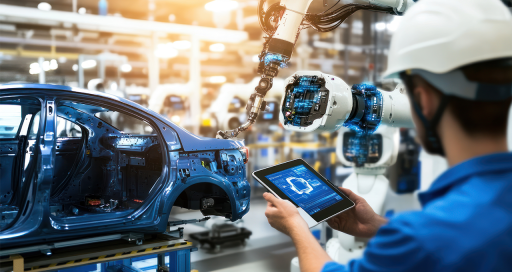
In the face of stiff competition, the transition to electric, and shrinking margins, automotive manufacturers are accelerating their digital transformation. From cloud technologies to digital twins and artificial intelligence – from Volkswagen to Renault and from Toyota to Ford – the automotive plant is undergoing a quiet but decisive revolution.
To remain competitive, Volkswagen has chosen to invest massively in cloud and AI technologies. In August 2025, the German group extended its partnership with Amazon Web Services for another five years. The aim is to continue development of its Industrial Cloud project, launched in 2019 with the ambition of connecting the group’s 122 factories to a single digital platform.
Between 2020 and 2024, this Digital Production Platform (DPP) has already been rolled out across 43 sites in Europe and North and South America. Through applications such as real-time data analysis, assembly-line optimisation and predictive maintenance, these digital tools are expected to enhance industrial efficiency and generate savings estimated at tens of millions of euros in the medium term. With this proactive strategy, the manufacturer plans to invest close to a billion euros in AI by 2030.
And Volkswagen is not an isolated example. All around the world, car manufacturers are undertaking similar transformations. BMW, for example, with its “iFactory” concept – one of the most advanced smart factory models around. The BMW group uses Google Cloud and digital twin technology to simulate its production lines before rolling them out for real. The outcomes are more flexible workshops, improved cost control, and an enhanced ability to offer customised vehicles.
But beware: “Cloud platforms are essential but not sufficient,” warns Joshua E. Siegel, Assistant Professor, Computer Science and Engineering at Michigan State University. “They require a whole package of fundamental abilities and a suitable business culture,” he explains to The Agility Effect. “Without these prerequisites, these platforms can generate significant costs and complexity for no competitive advantage. For smaller suppliers or manufacturers, on-site solutions or hybrid approaches are often equally effective in generating value in proportion to their cost.”
From lean manufacturing to the smart factory
The lean manufacturing pioneer Toyota is using AI to consolidate this tried and tested approach: collaborative robots, predictive maintenance, real-time adjustments to production rates, etc. The Japanese giant is launching multiple initiatives to reduce stoppages and waste, with the focus on continuous improvement “augmented” by data.
But it is the American firm Tesla that embodies the most radical model. Its gigafactories operate like software platforms. AI optimises the flows, autonomous robots perform tasks previously entrusted to human beings, and each production phase generates data, which is analysed immediately. This vertical integration enables the manufacturer to break out from conventional production cycles.
“The cloud platform requires a whole package of fundamental abilities and a suitable business culture”
At Renault, the 2026 Twingo, developed in China and produced in Europe, illustrates the French manufacturer’s strategy to accelerate its digital transformation by adopting the agile methodology, digital tools, software culture and digital engineering chains of the Chinese leaders in electric vehicle manufacture. The new Twingo was developed in just 21 months at its ACDC centre in Shanghai, with a prototype designed in four weeks, and for a price under €20,000.
In another sphere, the French manufacturer is – with Google Cloud – also pursuing a strategy based on predictive analysis, logistics and operational performance. Ford, with the same partner, is using artificial vision in its production plants to detect assembly defects in real time, significantly reducing recalls. As for Hyundai, its American factory Metaplant, designed from the outset to incorporate advanced robotics and AI, prefigures the next generation of smart factories.
Increasing technical complexity
For vehicle manufacturers, the benefits are tangible, with reduced production costs, improved quality, optimised logistics, faster responses to shortages and unexpected events, and greater scope for customisable vehicles.
But the transformation is not without its challenges. The increased number of connected systems makes production facilities more vulnerable to cyberattacks. And change requires new skills. There is a global shortage of talent, from data engineers to experts in industrial AI to cloud architects. To address this, most automotive groups have launched huge internal training programmes.
However, the dependence on the major American cloud providers also poses the question of technological sovereignty, particularly in Europe.
For Joshua E. Siegel, “Any analysis of ROI [return on investment] must take account of direct efficiency gains and also the value of the ecosystem. The latter, more difficult to quantify, relates to the activation of new functionality such as digital twins, predictive maintenance and real-time supply-chain optimisation.”
“Significant returns on investment,” he adds, “often come from the infrastructure and organisational changes needed rather than from the platform itself. The benefits accrue due to network effects, with partners taking advantage of the shared access to data.”
Toward “software-defined”
This industrial transformation is paving the way for further upheaval: the advent of the “software-defined vehicle”. Future vehicle models will be designed as scalable, constantly updating software platforms, requiring industrial infrastructure capable of managing immense volumes of data and intensely complex software (see below). Production plants themselves are also becoming “software-defined”: connected, modular, and capable of adjusting production in real-time and anticipating problems before they occur.
This ongoing transformation is making the cloud, data and AI central to industrial strategies. For a sector where every minute of stoppage costs a fortune, these tools are no longer supplementary – they determine a manufacturer’s ability to innovate, to produce rapidly at reasonable cost.
One key problem remains to be solved: dependence on a given provider. “This can lead to a spike in costs,” explains Joshua E. Siegel, “and the fragility of integration layers will make continuous maintenance necessary as the APIs evolve and the ‘technical debt’ accumulates. Operational dependency creates single points of failure, while concerns over sovereignty and data management are only increasing with the tightening of regulations.”
In this global race, the leaders will not necessarily be those who sell the best vehicles or the most advanced driver-assistance systems. It will also be those, and perhaps mostly those, who succeed in transforming their factories into true digital ecosystems. This is a colossal undertaking, but essential to building the car of tomorrow.
Is the car becoming a smartphone on wheels?
The modern car is no longer just a means of transport; it is becoming a mobile software platform featuring AI, connectivity and remote updates. Vehicle manufacturers are adopting the software-defined vehicle (SDV) – a car designed around its software architecture and able to reprogram itself, optimise its own performance, and activate options on demand. Volvo, Honda, Tesla and Hyundai-Kia are currently leading the way. Onboard digital services (voice assistants, connected navigation, streaming, personalised recommendations, etc.) are transforming the user experience and creating new revenue streams similar to Tesla’s OTA (over-the-air) subscriptions.
In Europe, take-up is slower: complex interfaces, poorly understood monetisation models and a lack of training for dealerships are limiting their use. China, on the other hand, is making the car a fully integrated digital product in which the interface, the personalisation and the fluidity of the services are all part of the experience. For Europe to succeed, manufacturers need to focus on user-centric design, simplify use, and think of the software not as an addition but a core driver of value and smart mobility.
Actemium: a key player in Industry 4.0
VINCI Energies is playing a key role in the automotive industry revolution and Industry 4.0 more generally. Its industry brand, Actemium, is rolling out the solutions at the heart of Industry 4.0. Actemium’s teams are embedding AI into existing robots to improve quality control and predictive maintenance. They are also modernising energy efficiency in factories, including at Aluminium Duffel in Belgium, thanks to energy-recovery drives and engines. Actemium is also developing digital twins and virtual-reality tools for designing and optimising assembly lines. It is also automating robotic cells, including welding units, for the Spanish equipment supplier Gestamp, highlighting the role it can play in smart automotive plants. Meanwhile Axians, the VINCI Energies ICT brand, is working to strengthen cybersecurity for industrial systems.
Find out more:
- “A new ‘ERA’: An action plan for the European automotive industry”, McKinsey, September 2025
- “AI in operations: Revolutionising the manufacturing industry”, PwC, May 2025
- “Global Gen AI in Automotive Market – 2025-2032”, ASD Reports, March 2025
04/16/2026